



In an era when travel can feel eerily interchangeable – the same menus, the same plates, the same borrowed ideas – Greek cooking continues to insist on difference. It does so not through reinvention or spectacle, but through fidelity: to land, to memory, to techniques passed down rather than scaled up. The result is a cuisine that remains defiantly local in a globalized world and, increasingly, celebrated for it.
One of the clearest signals of this renewed appreciation comes from TasteAtlas, a global food guide built from hundreds of thousands of verified ratings of dishes, products, and regional traditions, curated to reflect what people actually love to eat where it was born. While it has become a useful reference point for travelers and chefs alike, its latest rankings tell a deeper story than numbers alone. Greece placed second among all national cuisines worldwide, just behind Italy and ahead of Spain, Japan, and China, but more telling is what happened at the regional level.
Greek regions didn’t merely place well; they asserted themselves. Eight distinct Greek food regions earned spots among the world’s 100 best, each defined by its own ingredients, rituals, and sense of place. From island cooking shaped by scarcity and sea air to mountain cuisines built on preservation and patience, these regions confirm what Greeks have long known: there is no single “Greek cuisine,” only a chorus of fiercely individual ones. Just like in antiquity.
The reality, of course, is that most visitors won’t crisscross the country in pursuit of all eight. But nearly everyone passes through Athens, and that is where the story becomes even more interesting. The capital has quietly become Greece’s ultimate tasting hub: a city where regional cooking is not diluted but concentrated, interpreted by tavernas, bakeries, and ambitious chefs who treat tradition as a living language. In Athens, you can taste the country whole.
What follows is a look at the Greek regions that rose to the top 7 of the global conversation, what defines their cooking, why their future looks bright, and, crucially, where to experience their flavors in Athens today. Because if Greek cuisine is having a moment, it’s not a trend. It’s a homecoming.
→ For the full TasteAtlas list click here.
Greece’s Leading Food Regions, Tasted in Athens
Ranked 3 out of 100
Crete
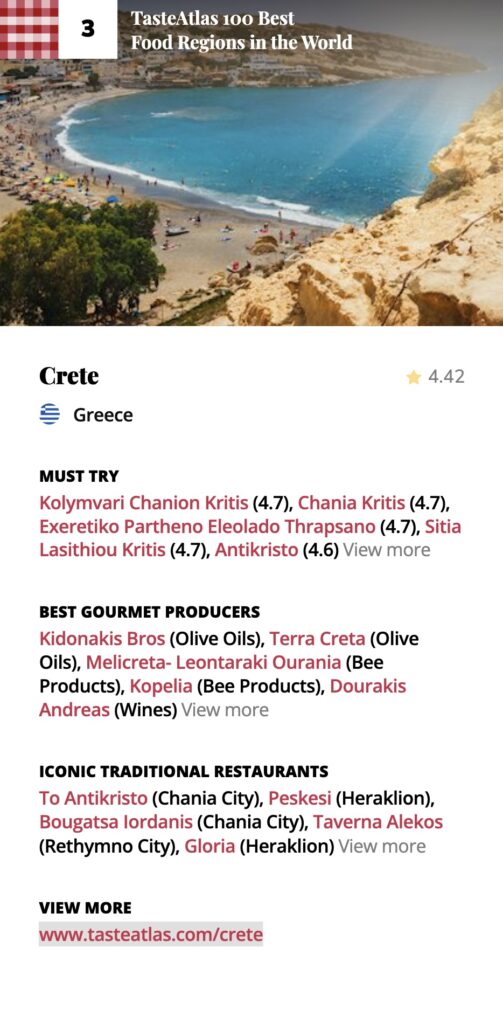
Crete’s cuisine is often cited as the purest expression of the Mediterranean diet, a food culture shaped less by abundance than by balance. Long before nutrition science took notice, the island’s cooking revolved around olive oil as its primary fat, an encyclopedic use of wild greens and herbs, pulses and whole grains, and meat employed sparingly, more as seasoning than centerpiece. It is a way of eating forged by geography and necessity, refined over centuries in mountain villages and coastal towns alike.
TasteAtlas’ regional profile catalogs dozens of Cretan dishes and products, from rustic breads and cheeses to slow-cooked legumes and herb-laced pastries, underscoring a cuisine defined by continuity rather than novelty. Techniques remain stubbornly traditional: hand-harvested olives pressed into peppery oils, foraged horta (boiled greens) gathered with local knowledge, and recipes transmitted orally, family to family. What emerges is not simply a regional cuisine, but a living system – one that continues to influence how the Mediterranean imagines itself at the table.
Crete in Athens

Katsourbos (Pagrati)
A restaurant with a clear Cretan identity: slow braises, handmade pies, and legume dishes driven by exceptional olive oil. Katsourbos‘ dining room is warm and unpretentious, service is knowledgeable, and menus reflect seasonal island produce rather than trends
Rakoumel (Exarxia)
Authentic, delicious, and generously portioned dishes that transport you to Crete. Rakoumel’s fennel pie with fresh herbs, small mizithra cheese pies, zucchini flowers stuffed with rice, potatoes with staka butter, skioufichta pasta with sausage, and more, that pair excellently with the organic raki.
Ranked 5 out of 100
Macedonia
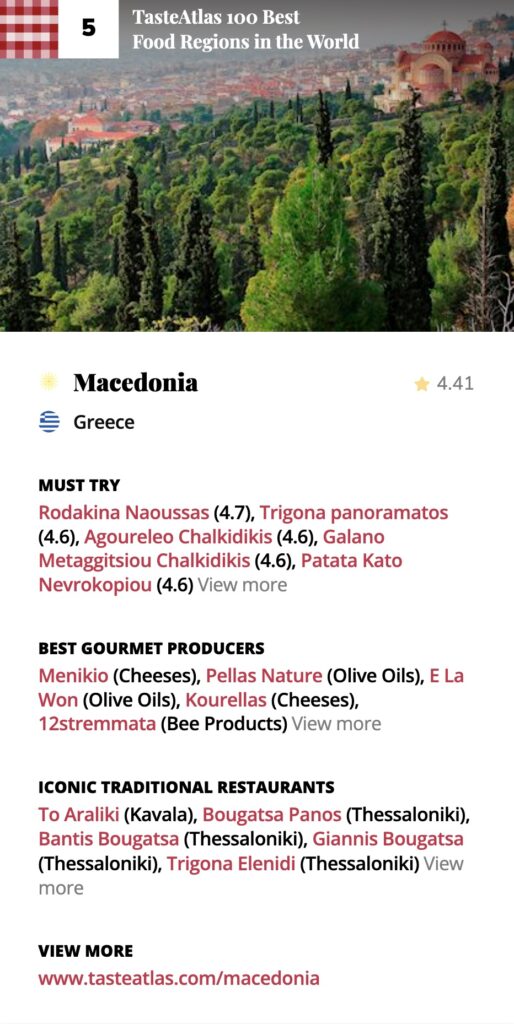
Macedonian cuisine reflects the rhythms of northern Greece, where colder winters, fertile plains, and a long tradition of both pastoral and urban cooking have shaped a heartier table. Influenced by centuries of Balkan and Anatolian exchange, the region’s food culture is built around meat and dairy, layered pies, robust meze, and dishes that favor the grill and the slow pot alike. Peppers, fresh and dried herbs, and preserved vegetables provide brightness and balance, cutting through the richness with purpose.
This is also one of Greece’s most dynamic wine regions. From the historic vineyards of Naoussa, renowned for age-worthy Xinomavro, to the cooler-climate whites and emerging reds of Amyndeon and Drama, Macedonian wines mirror the cuisine’s depth and structure. Whether paired with street foods like bougatsa or shared across communal tables laden with grilled meats and small plates, the cooking of Macedonia favors generosity, intensity, and an unmistakable sense of place – one that is tasted as clearly in the glass as on the plate.
Macedonia in Athens

Ta Vlachika (Vari)
A long-established reference for northern Greek and Macedonian meat culture in Athens. The menu is built around grilled and roasted meats associated with pastoral Macedonia. Lamb, suckling pig, kokoretsi, and hearty oven dishes, are served in generous portions at Ta Vlachika and with minimal embellishment. The setting is expansive and unpretentious, designed for communal dining, while service is efficient and experienced.
Ouzeri tou Laki (Kipseli)
A neighborhood ouzeri with strong roots in northern Greek and Macedonian meze culture, where small plates, seafood, and offal dishes are meant to be shared slowly alongside ouzo or tsipouro. The menu at Ouzeri Tou Laki favors classic preparations over reinterpretation, with flavors and pacing that echo Thessaloniki’s ouzeri tradition rather than Athenian taverna norms.
Ranked 6 out of 100
Cyclades

Cycladic cooking is a study in restraint, shaped by wind-swept terrain, mineral-poor soils, and an island logic that prizes clarity over excess. Pulses, barley rusks, sun-dried tomatoes, capers, and legumes form a quiet pantry, seasoned sparingly to allow the natural salinity and freshness of seafood to take the lead. The cuisine’s power lies not in embellishment but in precision, where a handful of ingredients are treated with confidence and intent.
TasteAtlas’ rotating Must‑Try selections for the Cyclades, which include local specialties such as Graviera Naxou and Fava Santorinis, offer a snapshot of this pared-back palate. What emerges is a cuisine that feels almost architectural in its composition – refined, deliberate, and deeply expressive of place, much like the islands themselves.
Cyclades in Athens


Balcony of the Cyclades (Vyronas)
Longstanding Athens institution focusing on island seafood and simple meze rooted in Cycladic ingredient logic. The very fresh fish at Balcony of the Cyclades is often grilled, the sauces kept simple to allow prime ingredients to shine, and the service friendly and well-versed in seafood nuances.
Amorgiano Perasma (Kallithea)
Amorgos cheese pies with honey and sesame, tomato keftedes, apaki (cured meat dish) with rusks and tomato, and notably, a delectably heartymeat pie can be enjoyed at Amorgiano Perasma. The monastery of Chozoviotissa in Amorgos is the origin of the raki recipe that has given this place its reputation.

The Peloponnese stands out for breadth and depth: olive groves, citrus farms, mountain pastures, and fishing harbours create a diverse food system. TasteAtlas’ regional listing points to top rated local products such as Finiki Lakonias olive oil and Kalamata olives, which act as anchors for everything from stews to salads.
Ranked 8 out of 100
Peloponnese
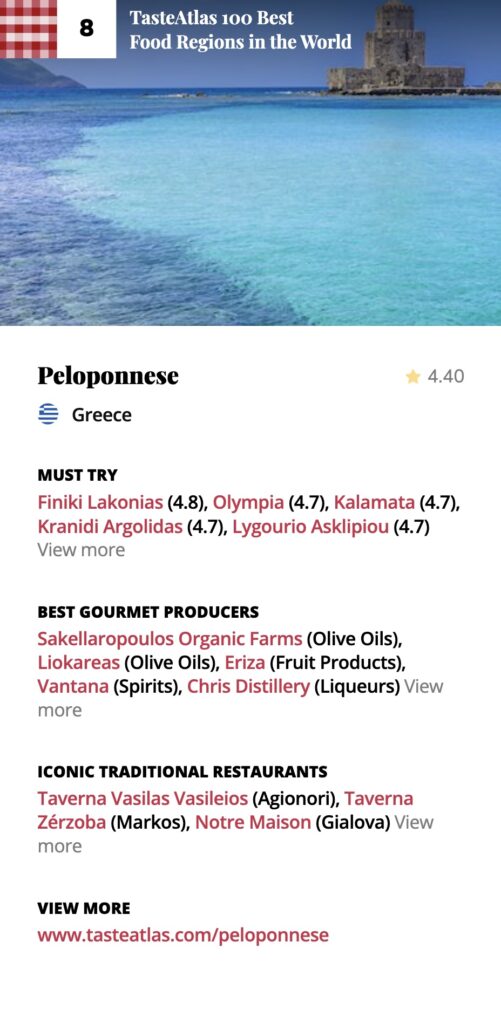
The cuisine of the Peloponnese is defined by agricultural excellence and a quiet confidence in its raw materials. Vast groves of olive trees dominate the landscape, producing some of Greece’s most prized oils and the globally recognized Kalamata olive, whose depth and balance anchor the region’s cooking. Dishes are built to showcase these fundamentals: vegetables glossed with fresh oil, breads and legumes enriched rather than masked, and flavors allowed to unfold without haste.
Fruit plays an equally central role, from citrus and stone fruit to grapes and figs, shaping both the savory and sweet traditions of the region. These harvests extend naturally into a culture of distillation and infusion, yielding refined local liqueurs and spoon sweets that reflect seasonality and restraint. Together, they form a cuisine of clarity and generosity, one that expresses the Peloponnese not through excess, but through the sustained excellence of what the land gives best.
Peloponnese in Athens

ManiMani
An unpretentious, regional-faithful kitchen with smoked meats, slow roasted dishes, and robust olive-oil-led vegetable plates. ManiMani is relaxed but committed to precision, and the service is well-versed in the sources of ingredients.
Arcadia
A traditional Athens taverna near the Acropolis Museum, focused on familiar Greek home-style dishes such as slow-cooked stews, roasts, and classic vegetable preparations. The atmosphere in Arcadia is relaxed and welcoming, with attentive service and outdoor tables on a pedestrian street.
Ranked 10 out of 100
North Aegean
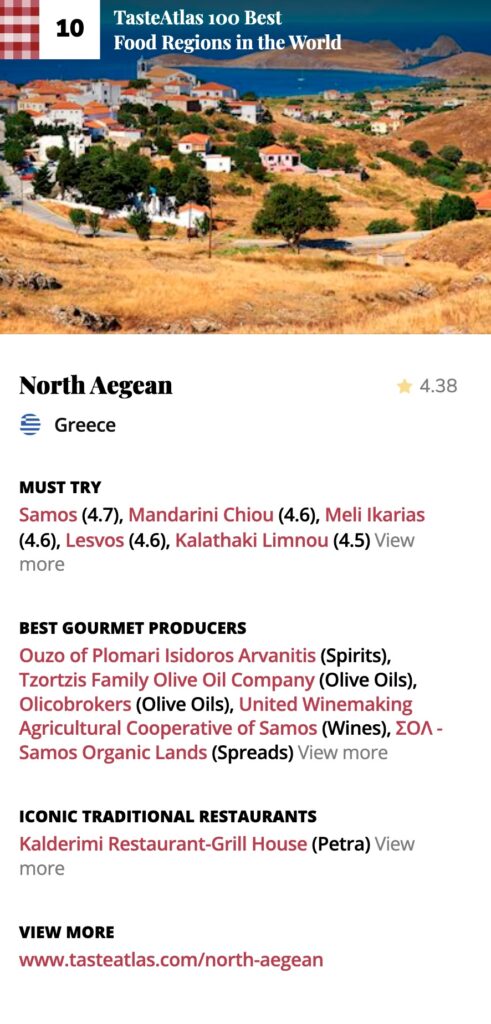
The cuisine of the North Aegean unfolds at the table in small, deliberate gestures, anchored in seafood drawn from deep, open waters, legumes simmered patiently, and aromatic herbs that thrive in salty air. It is a food culture inseparable from mezé, where dishes arrive in rhythm rather than sequence, encouraging conversation as much as appetite. The cooking is generous but never careless, shaped by island life and a long familiarity with the sea, and marked by a quiet modesty that resists excess or display.
What binds these flavors is a distinctive drinking culture. Anise-forward ouzo from Plomari, robust tsipouro, and the celebrated wines of Samos’ Cooperative provide structure and lift, while local olive oils lend a soft, grassy richness to even the simplest plates. Together, they capture the easy sophistication of the region’s seaside tavernas – unpretentious, expressive, and deeply attuned to place.
North Aegean in Athens

I Lesvos Ouzeri
An Athens ouzeri that channels the North Aegean’s small-plate rhythm, seafood meze, and distilled spirit culture. Informal service, focused pairings, and dishes designed to be shared as well as seasonal treats like Kalloni sardines, are what make I Lesvos so special.
Ouzeri tou Laki (Kypseli)
A long-standing ouzeri with a menu built around Aegean fish, shellfish, and classic meze, served in a relaxed neighborhood setting. The cooking at Ouzeri tou Laki prioritises freshness and balance, with flavors aligned to island tavern traditions rather than restaurant reinterpretation.
Ranked 15 out of 100
Thessaly
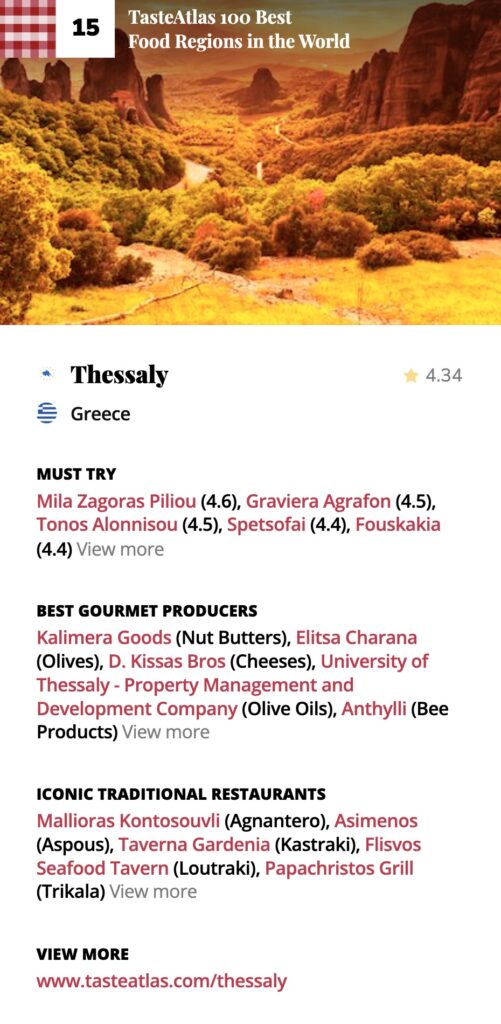
Thessaly’s cuisine is shaped by the fertile ground of Greece’s great plains, a landscape that has long sustained livestock, grains, and a cooking tradition unapologetically rooted in richness. This is one of Greece’s most substantial regional tables, built on meat, fat, and slow, confidence-inspiring techniques that reflect both agricultural abundance and colder inland rhythms. The food is generous and filling, designed to fortify rather than impress.
TasteAtlas highlights several defining products and dishes, including the crisp, aromatic Mila Zagoras Piliou (apples), the deeply flavored Graviera Agrafon (cheese), and the prized Tonos Alonnisou (cured fish), cured with restraint yet notable depth. At the table, dishes such as spetsofai – sausages simmered with peppers – and fouskakia, soft, fried doughs, underscore a cuisine that favors comfort and weight. Together, they form a regional cooking style that is hearty, grounded, and unmistakably tied to the sustaining power of Thessaly’s land.
Thessaly in Athens


O Thessalos
A casual Athens mezedopoleio drawing on Thessalian and northern Greek cooking, with a menu built around grilled meats, hearty small plates, and traditional flavors meant for sharing. The atmosphere at O Thessalos is lively and informal, with straightforward service that suits relaxed, table-led dining.
Thessalia Tavern
A well-established Athens taverna celebrating the flavours of northern and central Greece, with a menu that blends Thessalian and broader mainland dishes such as grilled meats, hearty casseroles, and seasonal vegetables. Thessalia’s setting is relaxed and hospitable, service attentive, and the cooking grounded in traditional techniques that honour the region’s agricultural and pastoral roots.
Ranked 37 out of 100
Ionian Islands
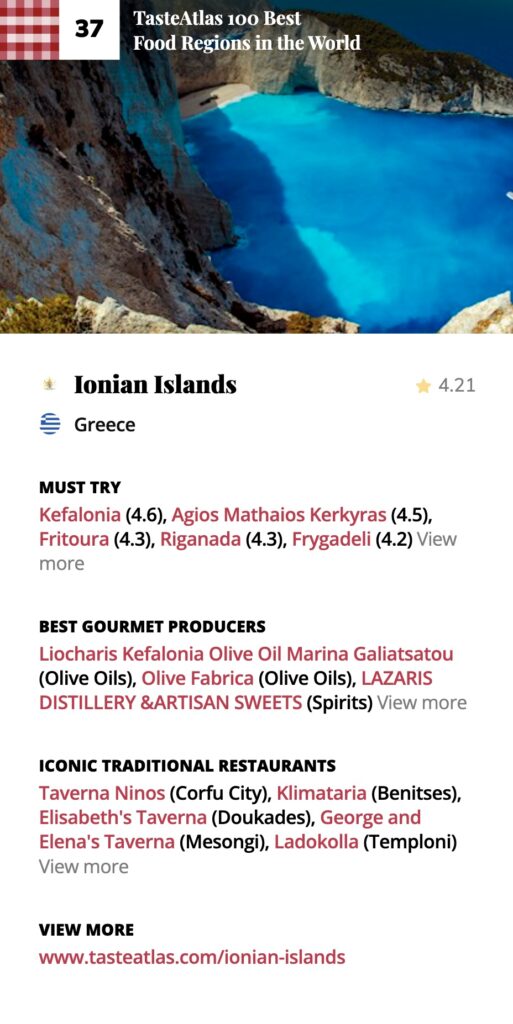
The cuisine of the Ionian Islands bears the imprint of centuries of Venetian rule, resulting in one of Greece’s most aromatic and sauce-driven regional tables. Rich tomato bases, warm spices, and slow braising distinguish the cooking, setting it apart from the lighter, oil-forward styles found elsewhere in the country. It is a cuisine that favors depth, refinement, and a certain Old World elegance.
Among its defining dishes are pastitsada (slow-braised rooster or beef in spiced tomato sauce) and sofrito (veal cooked in white wine and garlic sauce), both emblematic of the region’s patient, layered approach to flavor. Seafood appears in burdeto (spicy fish stew, often with scorpionfish), while the sweet tradition is represented by mandolato (nougat with almonds and honey) and frigania (custard-soaked dessert with syrup). Together, these dishes form a cuisine that is expressive, indulgent, and unmistakably Ionian in character.
Ionian Islands in Athens

Peinaleon
Dishes inspired by Chios, made with passion and homely touches, such as pork with mastic or the ‘hunkiar beyendi’, which journeyed from Turkey to the Aegean coasts and nearby islands, are paired with stuffed grape leaves (‘dolmades’), fresh salads bursting with aromatic herbs, and top-shelf spirits, bottled or straight from the barrel. On Wednesdays, live music at Peinaleon is performed unplugged, harmonizing perfectly with the gastronomic experience.
O Dyonisakis
A Zakynthian-inspired tavern in Athens that brings the Ionian island’s cuisine to the city with dishes rooted in local seafood, herb-rich sauces, and preparations influenced by Venetian-Ionian culinary traditions. The menu balances grilled fish, island meze, and hearty vegetable plates, served in a relaxed, friendly setting where service is warm and unpretentious.