







The gouri is one of Greece’s most enduring cultural symbols, rooted in a long tradition of customary objects carried for protection, prosperity, and continuity.
Long before it became a New Year tradition, the idea of a lucky charm existed in ancient Greek amulets, engraved gemstones, coins, knots, and talismans designed to ward off harm or attract favor from the gods. Over centuries, these practices took on layers of Byzantine symbolism, folk belief, and regional craft, evolving into objects that combined meaning with everyday use.
By the nineteenth century, the gouri had become closely tied to the turning of the year, a moment charged with hope, renewal, and intention. Today, Greek museums, galleries, and designers treat the gouri not as a novelty but as a compact cultural artifact. Whether inspired by archaeology, folklore, mythology, or contemporary art, each piece carries forward a distinctly Greek way of marking time: thoughtfully, symbolically, and with deep respect for material memory.
01
The Acropolis Museum


For 2026, the Acropolis Museum turns to the layered history beneath its foundations. The official gouri draws on mosaic motifs uncovered in Building Z’, dating to the sixth century CE, translating ancient geometry into a contemporary pendant. Designed by Greek creators Konstantinos Dimopoulos and Giorgos Chronis, the piece – in a larger and smaller rendition – balances symmetry and movement, echoing ideas of abundance, continuity, and protection. Made with a clear scope, it feels purposeful rather than decorative, a charm that carries cultural weight without excess. It is meant to be worn daily, close to the body, as a quiet reminder of Athens’ uninterrupted dialogue between past and present.
02
Museum of Cycladic Art


For 2026, the Museum of Cycladic Art presents two γούρια that speak through abstraction and lightness rather than literal reference. Bourboulithra, designed by PARI, is a small circular pendant in gold-plated silver, conceived as a bubble-like fish form punctured with tiny stars and moons. Hung on a multicolored cord, it reads as playful and talismanic, compact and intentionally uncomplicated. Alongside it, a second lucky charm takes the form of a short necklace composed of small, rounded gold-plated elements linked rhythmically along a fine chain. Worn close to the collarbone, it relies on repetition, proportion, and simplicity.
03
The Benaki Museum


For 2026, the Benaki Museum presents γούρια rooted in Greece’s material and folkloric heritage, translated into contemporary metalwork by two designers. One design, created by Maria Lioni, draws on the silver-thread vegetal embroidery of a nineteenth-century felt waistcoat from Kastoria, part of the museum’s Folklore Collection, and is released in silver, gold-plated silver, and silver with gilt details. Alongside it, Katerina Koukou presents a stylised onion-shaped charm in silver, worn on a coloured cord. With its layered lines and serrated outline, the piece references everyday symbols of protection and resilience, offering a tactile, wearable object that bridges domestic tradition and contemporary design.
04
Elena Votsi

Elena Votsi is known for jewelry that privileges concept and participation, most famously through her redesign of the Olympic medal. Her approach to the gouri follows the same logic. For 2026, she presents a single, clearly defined design: a pencil-shaped lucky charm crafted in sterling silver and wood. The charm comes with a small piece of paper on which the owner writes a wish, placing intention at the center of the object. There are no symbolic variations or alternate motifs; the emphasis is on ritual rather than multiplicity. Once used, the silver element remains as a pendant, carrying memory rather than message. It is a thoughtful, restrained interpretation of luck as action rather than ornament.
05
Zeus + Dione


Zeus + Dione approaches the gouri through the lens of heritage filtered into contemporary design. For 2026, the brand releases a small group of lucky charms built around the Asteria motif, referencing stars and navigation in Greek mythology. Thethe core design remains consistent, but it appears in different lengths, scales, and finishes, allowing for subtle personalization. The charms are elegant and wearable, designed to integrate easily into everyday dressing rather than stand apart as ceremonial objects. As with the brand’s wider collections, symbolism is present but controlled, offering a sense of direction and continuity without overt narrative.
06
Lalaounis


LALAoUNIS has long treated mythology as a living design language, and its gouria are among the most established in Greece. For 2026, the house presents multiple versions of the Pegasus charm, offered in different sizes and material combinations, including sterling silver and gold with silver. The variations allow for different price points and wearing preferences, while the motif remains fixed. Pegasus functions here as a symbol of freedom, imagination, and forward movement, rendered with the technical precision that defines the house. These are traditional gouria in the clearest sense: symbolic, collectible, and intended to be worn across generations.
07
Yannis Sergakis


Yannis Sergakis’ Lucky Charm 2026 places the idea of cosmic love at the center of the year ahead. Titled Cosmic Love, the piece reflects the designer’s long-standing approach to jewelry: light, fluid, and quietly radiant. At its heart is labradorite, chosen for its shifting metallic tones, with each stone entirely unique. Depending on the light, it reveals shades of green, blue, and deep brown, creating an effect that feels almost otherworldly, like a miniature disco sphere from a distant galaxy. Available as a pendant or brooch, with or without diamonds, the charm comes in four variations. Handcrafted and gold-plated, it functions as a wearable affirmation, a reminder to move through the year with freedom, harmony, and a sense of joy.
08
Katerina Psoma

Katerina Psoma is known for jewelry that communicates directly, often through text, color, and bold form. Her gouria for 2026 appear in multiple distinct designs, rather than variations of a single motif. These include message-based charms, such as Fear Not, alongside symbol-led pieces incorporating eyes, medallions, or cross forms. Each design stands on its own, allowing the wearer to choose between verbal affirmation or visual symbolism. The materials and scale are consistent with Psoma’s broader collections, making the gouria easy to layer or wear alone.
09
Minas

Minas is rooted in sculptural jewelry, with an emphasis on form, proportion, and material presence. While the house does not produce extensive gouri collections, certain annual pieces function clearly as lucky charms. For 2026, the As One pendant is offered in different metals and sizes, with variation based on material rather than design. The interlocking form suggests unity and balance, without relying on explicit symbols. The piece reflects the house’s belief that meaning can emerge from structure alone. It appeals to those who prefer abstraction over iconography, offering a quiet, enduring approach to the idea of luck.
10
Theodora D


Theodora D works within a clean, contemporary aesthetic, often revisiting traditional symbols with precision. For 2026, she releases several gouria built around clearly defined motifs, most notably the eye and medallion forms. These appear in different metals and color finishes, allowing variation without altering the underlying design language. The charms are flat, balanced, and designed to layer easily with fine chains. Symbolism is direct and readable, aligning with the brand’s accessible approach to jewelry. The range offers choice without complexity, making the gouri both recognisable and adaptable to everyday wear.
11
Zolotas
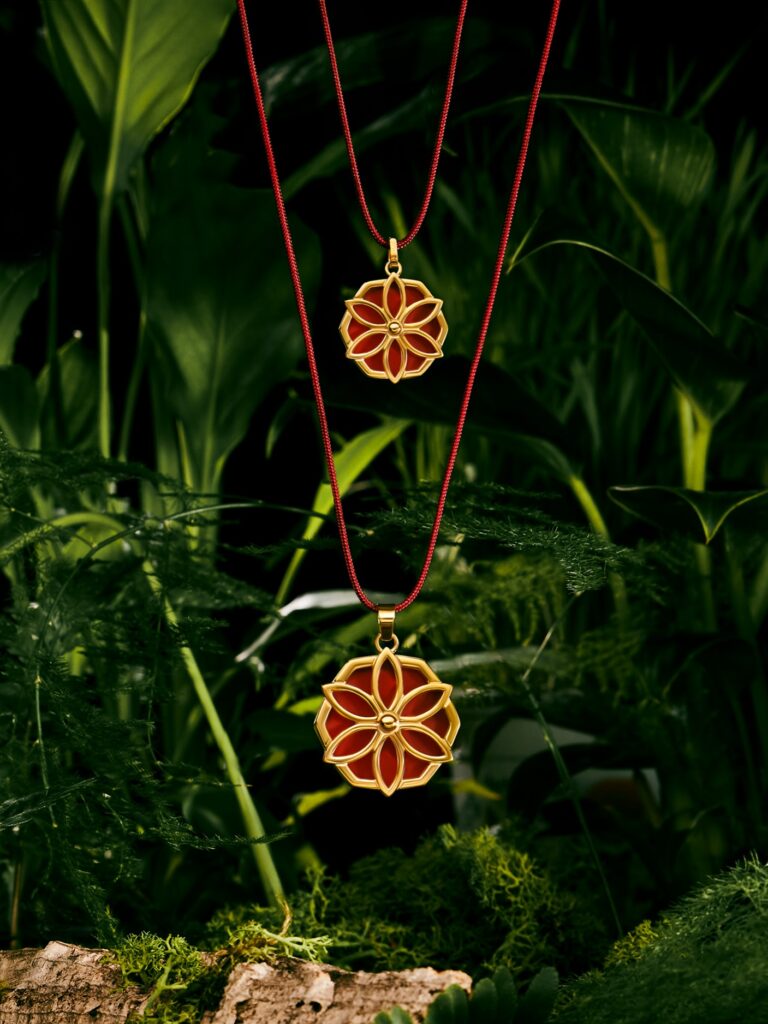
For 2026, Zolotas turns to one of the oldest geometric symbols shared across ancient cultures: the Flower of Life. Long associated with natural order and cosmic balance, the motif appears throughout the visual languages of Babylonian, Assyrian, and Mycenaean civilizations, as well as in Homeric-era Greece, where it adorned garments, jewelry, and ceramics. Interpreted through a contemporary lens, the ZOE lucky charm explores the symbol’s dual nature: expansive when repeated, concentrated when held within a circle. The result is a collection of jewelry that channels ideas of renewal, stability, and creative force. Offered as pendants, rings, bracelets, and earrings in 18k gold and silver, and accented with carefully selected gemstones, ZOE is conceived as a wearable emblem for the new year—structured, luminous, and enduring.
12
Christina Soubli

The Dazzling Peacock is Christina Soubli’s lucky charm for the new year, designed as a pendant in the shape of a stylised crest. At its center sits a peacock rendered in deep green and royal blue enamel, accented with gold-toned details and finished with a small turquoise bead that hangs freely below. The composition is precise and decorative, balancing color with structure. Traditionally associated with renewal, confidence, and good fortune, the peacock is presented here as a wearable emblem rather than a statement piece. Worn close to the body, the charm functions as a personal talisman for the year ahead, combining symbolic clarity with everyday elegance.


