







Every now and then a quiet, everyday ingredient surprises the world. This year it was Graviera Naxou. TasteAtlas has crowned the Naxian cheese number one among the world’s best, propelling a Cycladic staple into international fame with best producers being Graviera Pittara and E.A.S. Naxos.
Last year, the winner was Italy’s Parmigiano, with Graviera in second place. Smooth, pale-gold and aromatically gentle, the PDO-protected cheese now stands at the top of a global list shaped by some of the world’s most selective gastronomy experts.


TasteAtlas, a digital atlas of traditional dishes, ingredients and culinary heritage, gathers millions of user ratings alongside expert evaluations to map and rank foods based on real-world appreciation rather than marketing or prestige. Its lists are closely watched because they reflect how dishes perform across borders, cultures and palates.
Graviera Naxou is a hard table cheese with a refreshing taste and light aroma, a thin natural rind, pale yellow interior and compact structure with small, regular holes. TasteAtlas notes the cheese’s composition of “maximum moisture of 38 percent” and “at least 40 percent fat in dry matter,” which give the cheese its satisfying richness. It even credits the island’s terrain, explaining that the milk comes from animals grazing freely among Naxos’ wild herbs, shaping a flavor tied directly to the landscape.

The Story Behind the Cheese
Naxos is unusual in the Cyclades for its fertile plains and long agricultural tradition, and this is one of the reasons its graviera evolved differently from the sheep-heavy cheeses of Crete, Lesbos or the mainland mountains. Graviera Naxou is defined by its milk: by PDO specification, at least eighty percent must be cow’s milk from locally raised herds, with the remaining portion, if used, made up of sheep’s or goat’s milk. That choice gives a softer, rounder flavor than other Greek gravieras.
The cheese began taking recognizable shape in the mid-twentieth century, when cattle farming intensified on the island and local cooperatives looked for ways to transform abundant cow’s milk into a hardy, exportable cheese.
By the 1950s and early 1960s, organized production was underway, and in 1996 the cheese officially earned its PDO status. Over time, Graviera Naxou developed a distinct profile: firm yet elastic, pale yellow, dotted with tiny holes, and flavored with the subtle sweetness of the island’s pastures. Young wheels taste buttery and mild; older ones lean toward toasted nuts and warm caramel notes.
How it Shows Up on Greek Tables
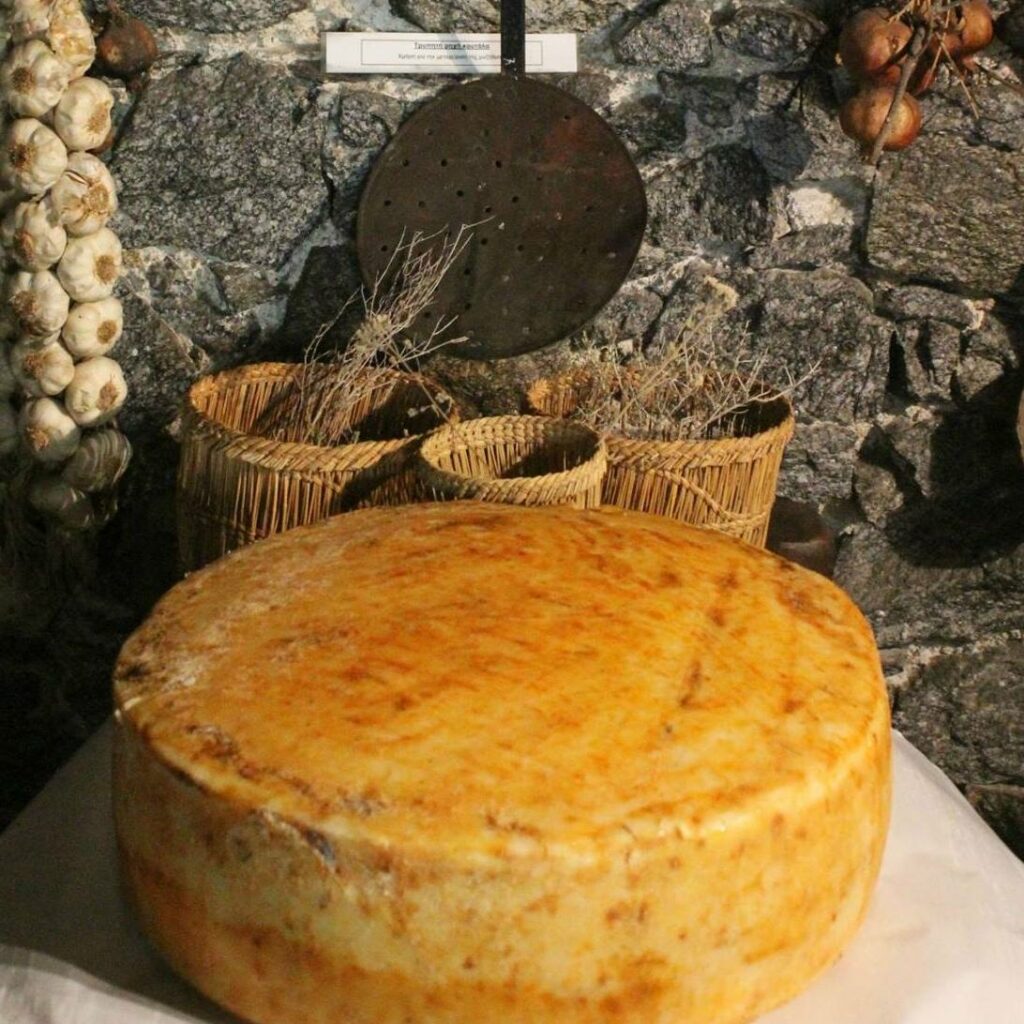
Graviera Naxou is one of those cheeses that knows exactly how to behave in a Mediterranean kitchen. The simplest preparation might be the best: a thick slice laid next to ripe tomato, a drizzle of olive oil and a piece of barley rusk. The combination speaks for itself – a balance of sweetness, acidity and richness that turns a handful of ingredients into a meze worth lingering over.
The cheese is one of the classic stars for a most satisfying saganaki, because it browns beautifully without collapsing. Lightly floured, pan-fried until crisp at the edges and softened inside, it becomes a warm, golden triangle of comfort. A squeeze of lemon brightens it; a trickle of honey makes the nutty character shine. A drizzle of olive oil brings out its creaminess, and a sprinkle of thyme gives it an earthy kick. On Naxos, you might even find it paired with pickled peppers for a sharper contrast.
Grated graviera is a kitchen workhorse. It melts well into béchamel for pastitsio, forming a burnished crust in the oven. It adds body to casseroles and vegetable bakes with potatoes (another well known Naxian PDO product), zucchini or eggplant, settling into little molten pockets. It is used in pies, tucked among greens or between layers of dough, adding depth without overwhelming the filling.
More modern interpretations treat it as an elegant table cheese. Thin curls of aged Graviera Naxou bring warmth to a rocket salad with figs and walnuts. Cheeseboards pair it with quince spoon sweet, apples or late-summer stone fruit. With wine, it plays well with bright whites or soft reds that echo its gentle sweetness while cutting through its creamy density.

Why The Win Matters
Recognition from TasteAtlas carries weight because the platform combines cultural documentation with crowd-sourced authenticity. Foods rise in its rankings only when an international community of diners consistently rates them highly, regardless of trend or hype. When a cheese from a relatively modest Cycladic island reaches number one, it means people around the world have not only tried it, but remembered it, delighted in it and selected it above countless iconic competitors.
For Naxos, the accolade validates decades of disciplined production and a commitment to local methods. For Greece, it broadens the global conversation around its cheese culture, which is far richer and more varied than the stereotypes of feta alone. And for anyone discovering Graviera Naxou for the first time, the ranking is an invitation to taste a cheese shaped by soil, herbs, sea air and the quiet craftsmanship of an island that has always known its worth.


