



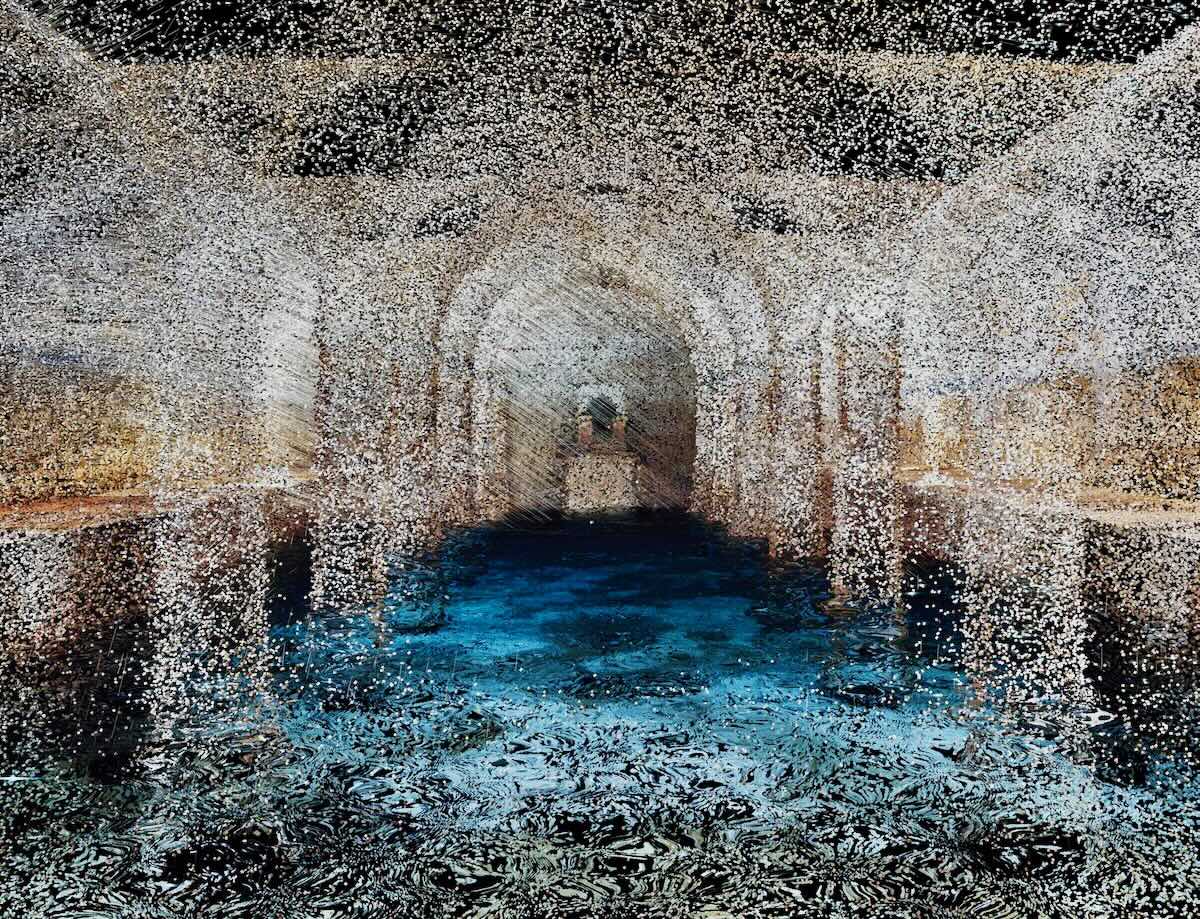
Until April 30, one of the most unusual events in Athens is taking place in Kolonaki, where the Athens Digital Arts Festival has brought contemporary media art into direct contact with one of the city’s oldest infrastructure works.
In collaboration with EYDAP, the festival is presenting NEOn NERO at Dexameni Square, the historic site of Hadrian’s Aqueduct and its reservoir, turning a largely unseen part of Athens into a nightly audiovisual experience. This is what makes the project stand out: it is not simply an exhibition placed in an attractive location, but a digital arts event built around the physical, historical, and civic meaning of the site itself.
Dexameni is more than a pleasant square at the foot of Lycabettus. Its name comes from the reservoir connected to Hadrian’s Aqueduct, a major engineering work commissioned in the second century AD under Emperor Hadrian, whose building program left a lasting mark on Athens.
Constructed between AD 134 and 140, the aqueduct carried water from the foothills of Parnitha toward the city and ended at the Hadrianic Reservoir in the area of today’s Kolonaki. For centuries, it fulfilled the vital role of supplying Athens with water. It belonged to the practical, essential life of the city, and its importance extended far beyond technical ingenuity: water determined whether a city could expand, how it could function, and what kind of daily life it could sustain.
Its great signbificance did not end with Roman Athens. The aqueduct continued to operate until the Ottoman period, when damage and neglect gradually reduced its use and residents turned increasingly to wells. In the 19th century, after Athens became the capital of the modern Greek state, the system regained importance.
The aqueduct was rediscovered and repaired in the 1840s, and in 1870 the buried reservoir at Dexameni was identified and reconstructed, operating until 1940. This long period of use gives the site a different kind of historical weight. It is not an isolated monument from a remote past, but part of a continuous urban history that reaches into modern Athens.
That continuity is still legible in the square itself. Dexameni has always felt slightly apart from the more fashion-cenytric and crowded sections of Kolonaki. Its scale is smaller, its pace quieter, and its identity has been shaped by habits that belong to everyday Athenian life in the sun rather than display. The open-air cinema and the cafe outside it have made it a familiar stop for generations, and the square also holds a literary history as a hotspot associated with major Greek writers and poets. The reservoir, by contrast, has largely remained out of everyday view, visible only in fragments and opened on limited occasions. That gap between what Athenians know and what they overlook gives this exhibition much of its force.
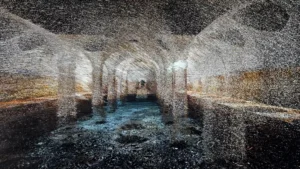
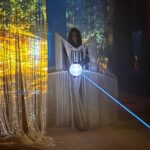
NEOn NERO does this by using contemporary artistic tools to reveal what has been hidden in plain sight. Produced within the framework of the Athens Digital Arts Festival, the installation combines sound, light, moving image, environmental data, and performance. Real water-quality data shape the audiovisual environment, while 3D scans of the reservoir and forms derived from hydrological routes and neural networks structure the work visually. Its sequence unfolds through four conditions, Darkness, Water, Heart/Aqueduct, and Memory, allowing viewers to encounter the aqueduct as both ancient construction and present-day system. The festival’s role here is essential: it frames the monument not as a static historical object, but as material for contemporary artistic interpretation and public re-engagement.
That is why this exhibition is worth seeking out. It offers visitors a different way to understand Athens, through water, infrastructure, and the city below street level. It also shows what the Athens Digital Arts Festival can do at its best: use digital art not for spectacle alone, but to change how a place is read.
NEOn NERO runs at Hadrian’s Aqueduct, Dexameni Square, Kolonaki, through April 30. Admission is free. Opening hours are daily from 19:30 to 22:30, with live performances on April 25 to 26, from 20:30 to 21:20. Admission is free. (The hidden entrance to the cistern sits inside a unassuming 19th-century white building, tucked right next to the open-air cinema.)