


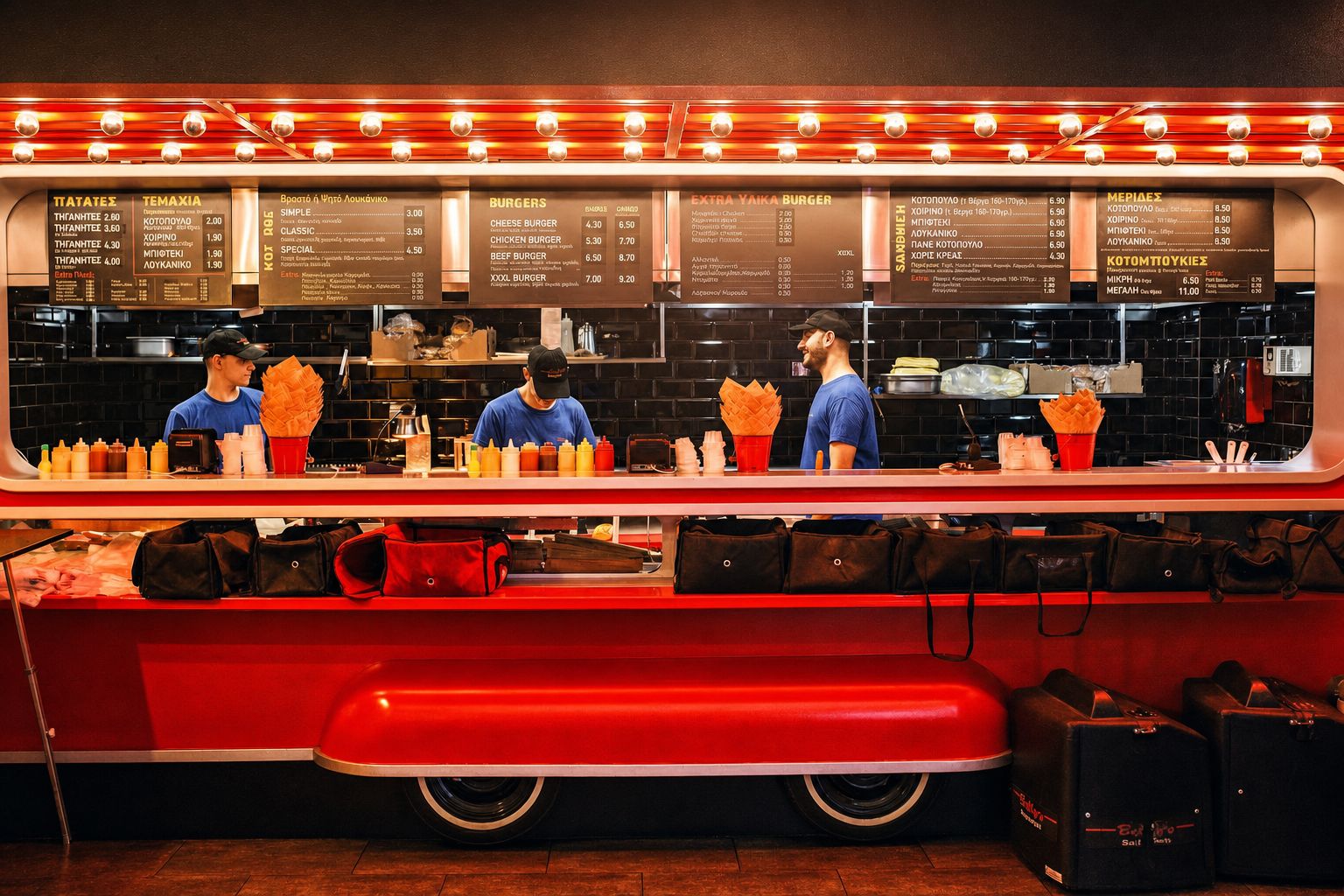
Paris took the crown, and nobody in Greece seemed to mind. When researchers at Radical Storage, the luggage storage company, finished combing through 6,897 street food eateries across the world’s 100 most visited cities this spring, the French capital landed at number one with a score of 7.2 out of 10. But look one line down, and then another, and then three more, and a different story emerges. Athens is second. Thessaloniki is third. Rhodes is sixth. No other country placed three cities in the global top 10. Not Italy, not Spain, not Vietnam. Greece did it almost without noticing.
There is something fitting about that. Street food in Greece has never been a performance. It is a habit, older than the word itself, practiced daily at the koulouri cart outside the metro, at the souvlatzidiko where the grill has not cooled since the eighties, at the bakery window where the tiropita comes out at seven sharp because that is when it has always come out. Athens earned its second place on range and density, with 29 cuisines counted and 4.21 vendors per square kilometre, a figure that beats Paris. It is also, officially, the cheapest street food city on earth, with 81.5% of its vendors falling into the budget-friendly category. The numbers describe what any Athenian already knows: you are never more than a short walk, or a few euros, from something worth eating with your hands.
Thessaloniki’s third place surprised no one who has ever queued there for a bougatsa at dawn, still warm, dusted with sugar and cinnamon, eaten standing up because sitting down would be missing the point. The city turns out to have the densest street food scene of any city in the top 10, at 4.66 vendors per square kilometer, and it has argued for a century that it is the country’s true food capital. Now it has an international ranking to fold into the argument, right below its Athenian rival, close enough to keep the debate alive.
And then there is Rhodes, the unexpected one, an island of medieval walls and package holidays that outranked Rome overall and beat every city in the study on quality alone. Fully 83% of its vendors are rated four stars or higher, the highest proportion anywhere in the world, ahead of Florence, ahead of Edinburgh, ahead of everyone. Its presence on the list is perhaps the most telling detail of all. It suggests that Greek street food excellence is not a metropolitan phenomenon but a national baseline, as reliable on a Dodecanese side street as it is in Exarchia. Heraklion, for good measure, ranks second in the world for value, so even the tables Greece does not top, it crowds.
None of this required a campaign. There were no ministries of gastronomy, no rebranding exercises. There were only decades of pitas folded the same careful way, sesame rings stacked on poles at dawn, and the stubborn Greek conviction that food eaten on the move deserves the same seriousness as food eaten at a table. The world’s researchers simply arrived, counted, and confirmed it. Three cities in the top 10, four across the tables that matter, one country. The Greeks, as ever, will accept the news with a shrug, a squeeze of lemon, and the quiet certainty that they knew it all along.
Read more:
The 30 Best Street‑Food Stops in Athens, Bite by Bite