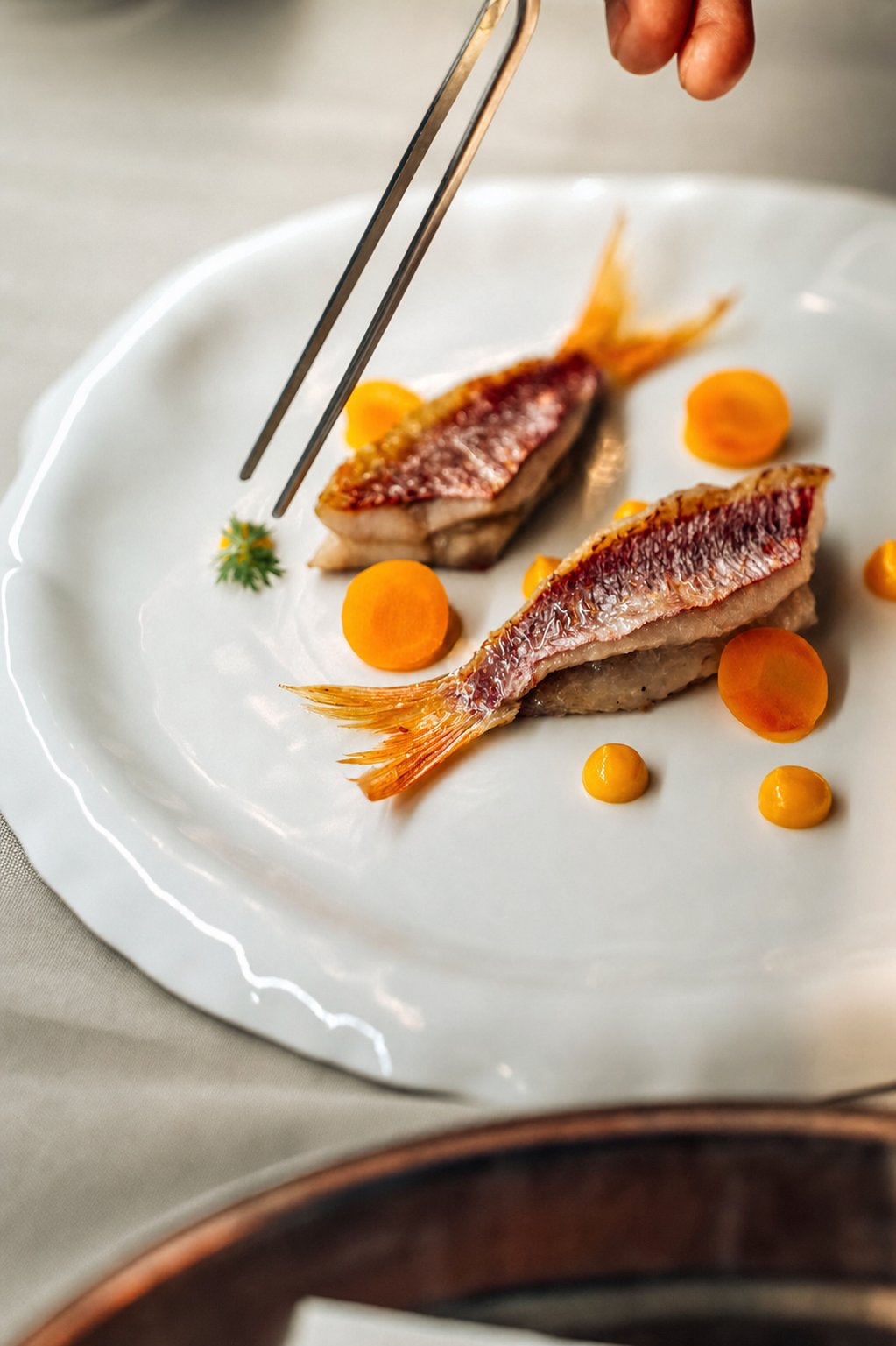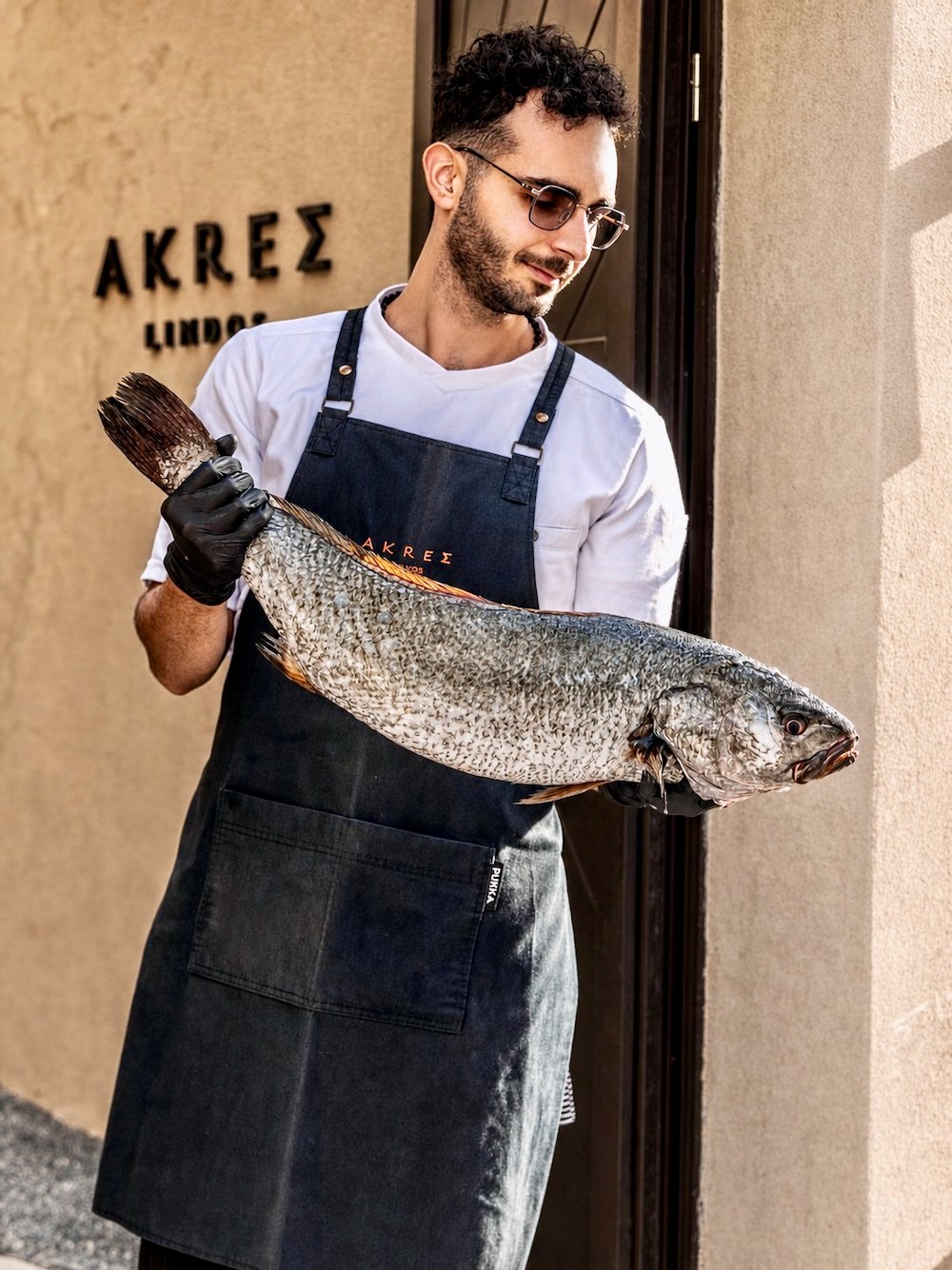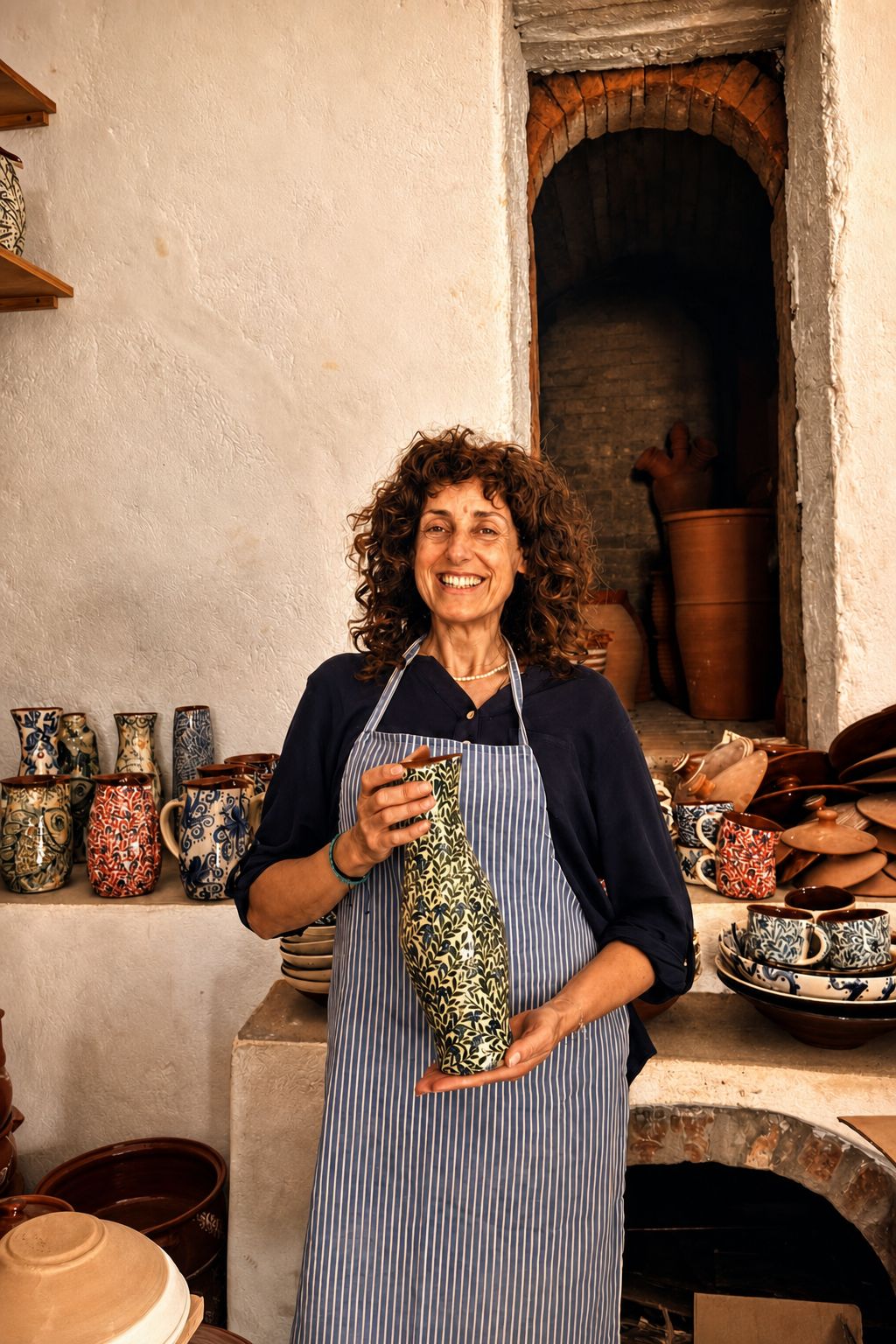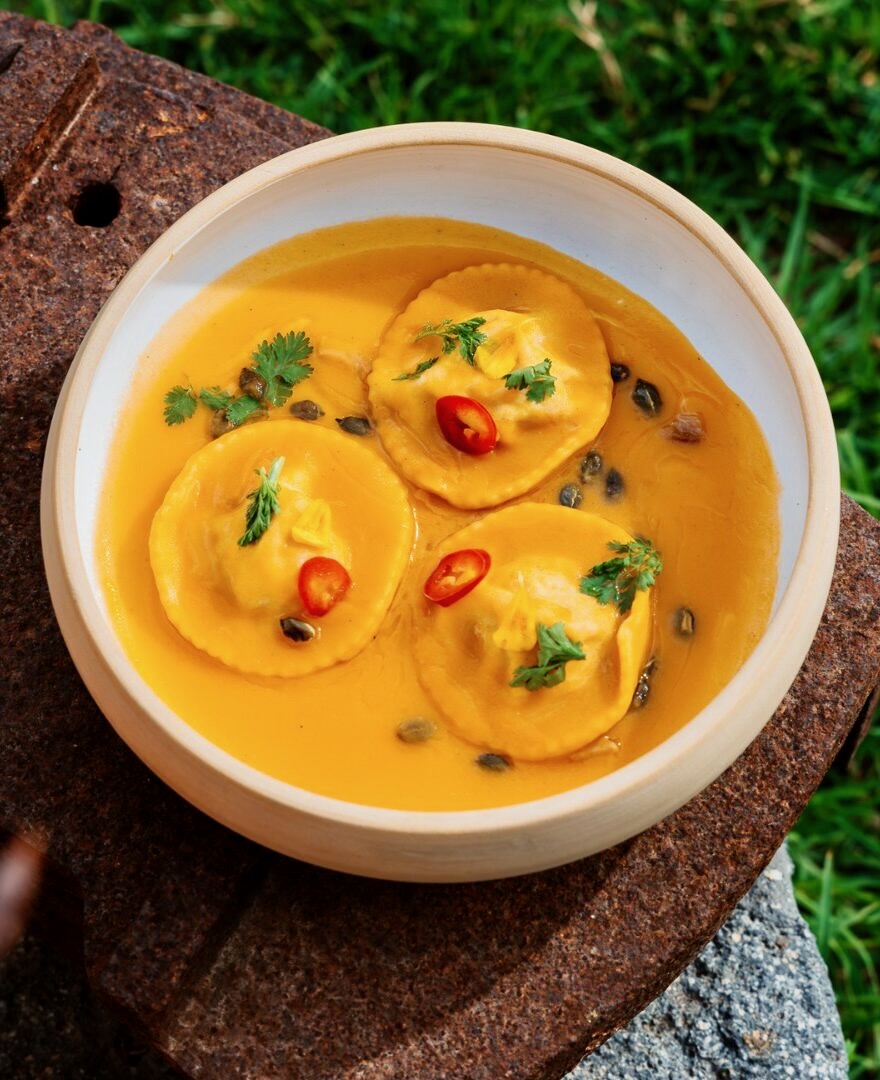



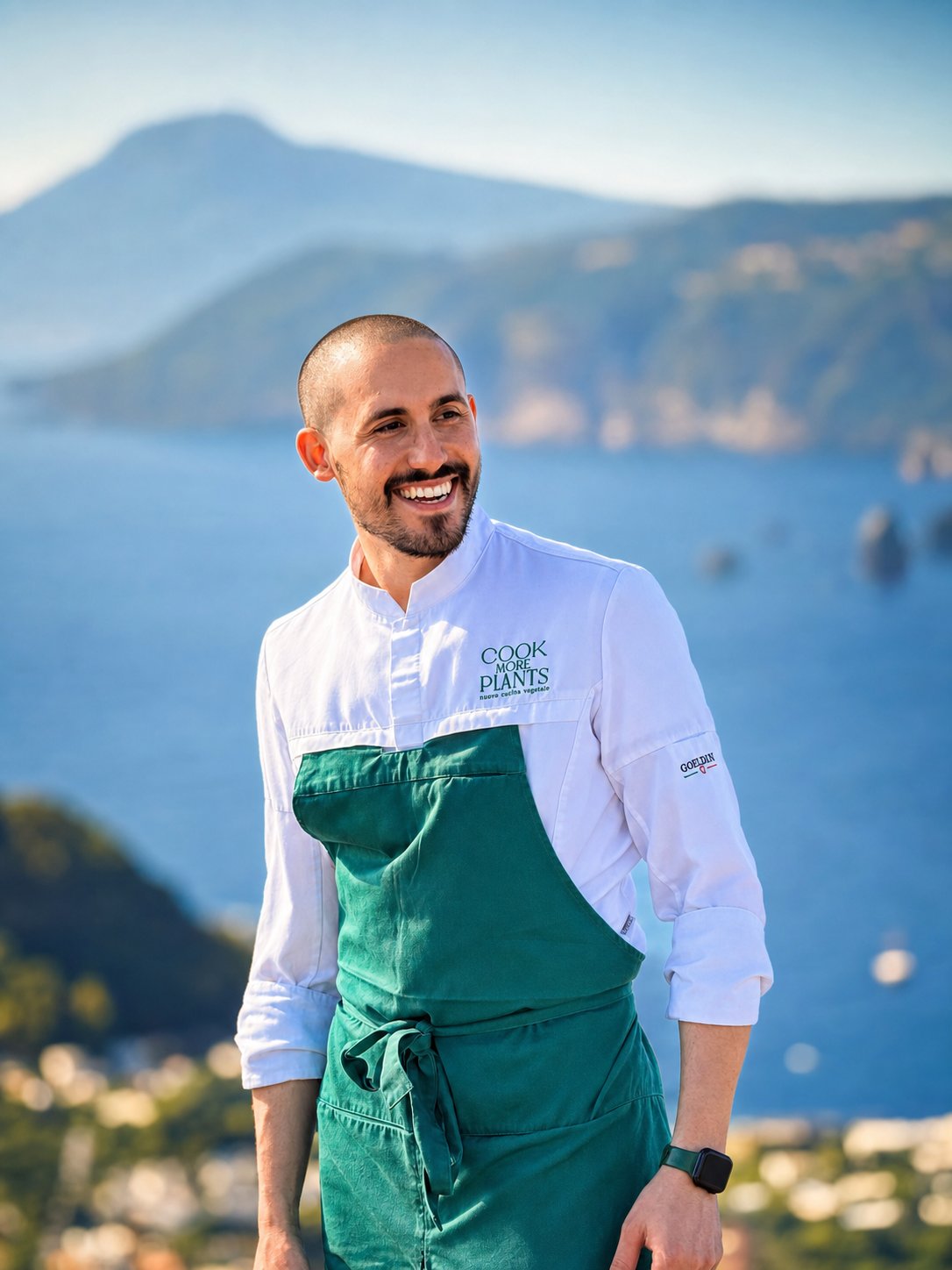
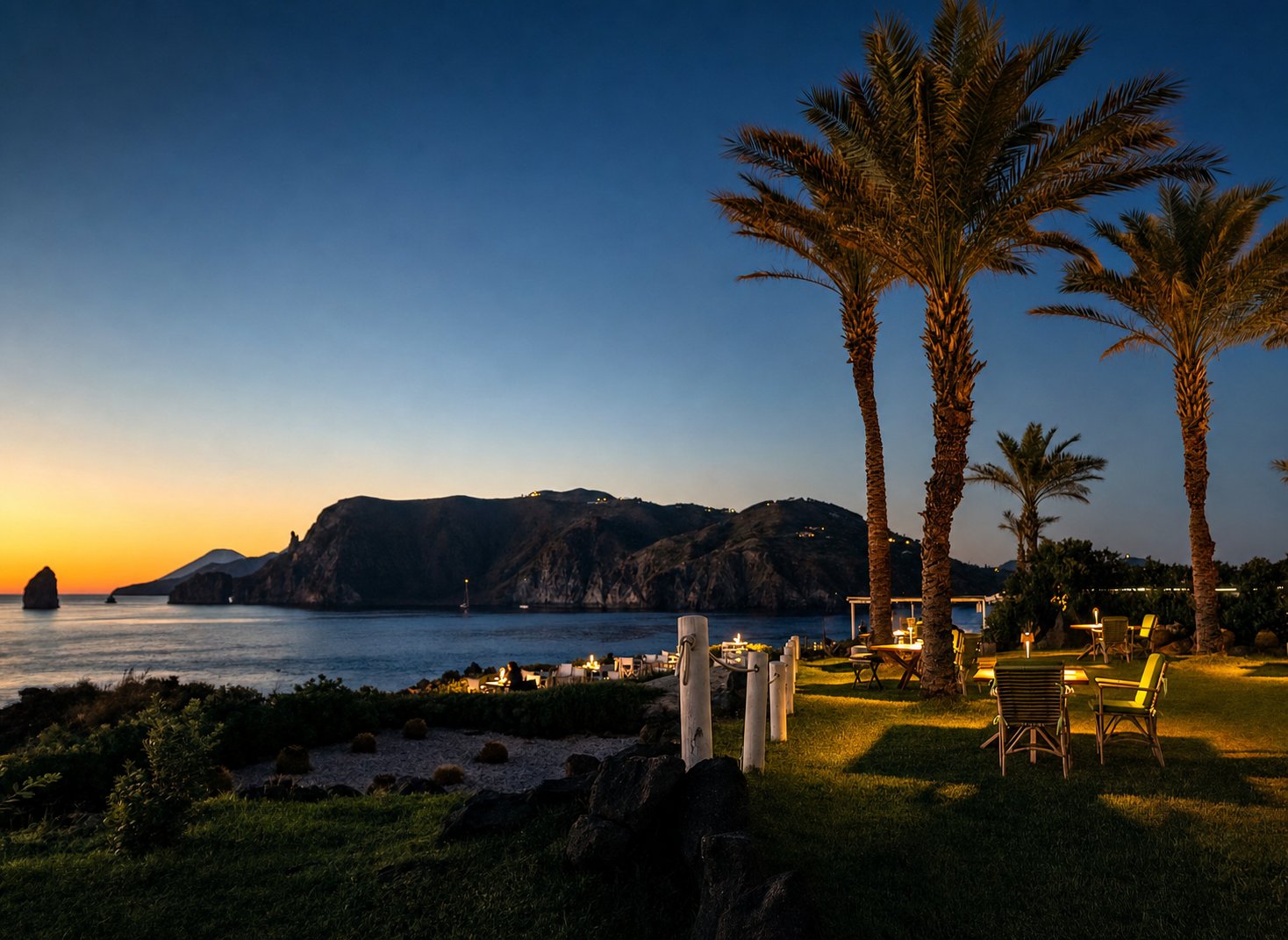
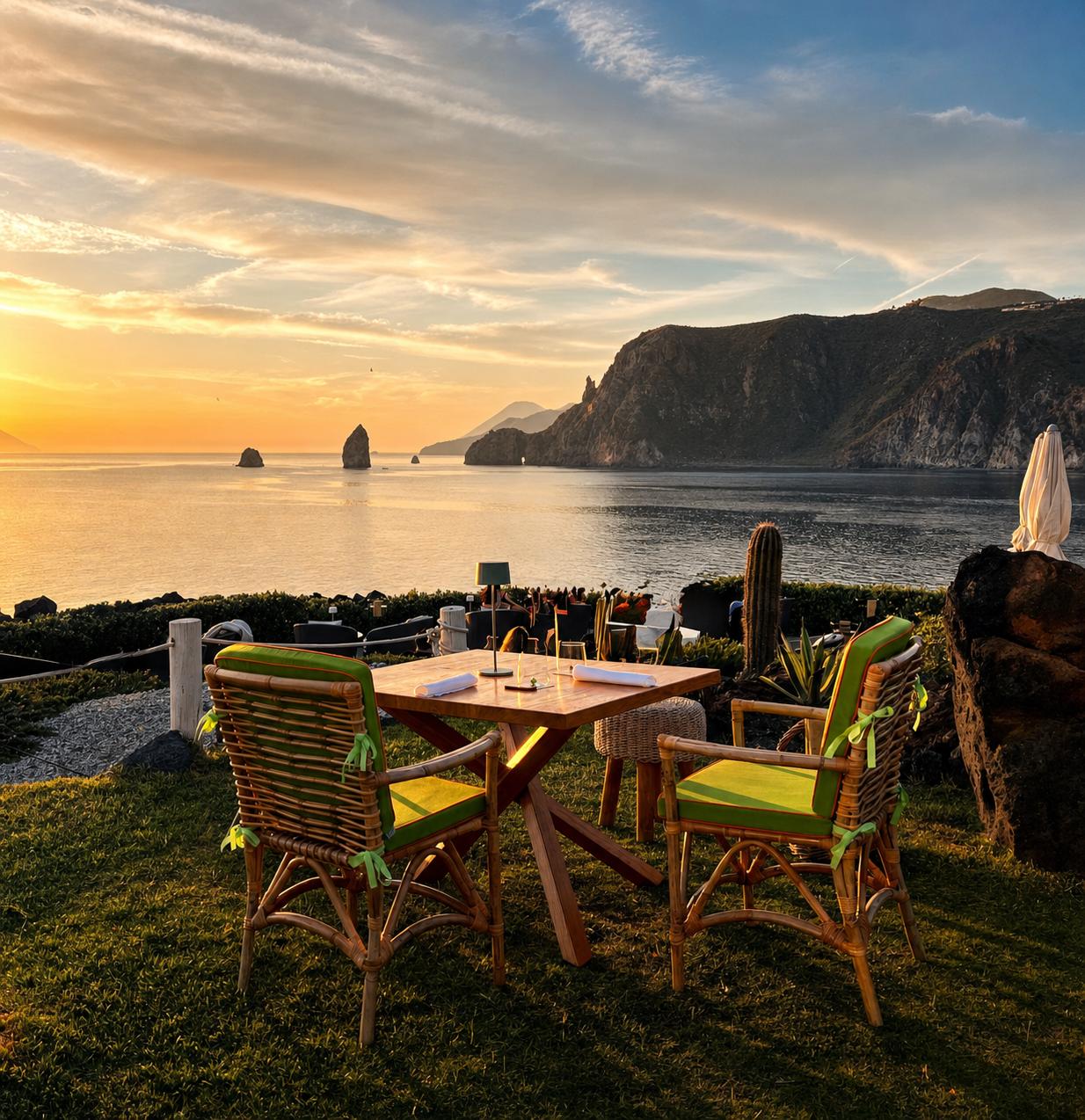
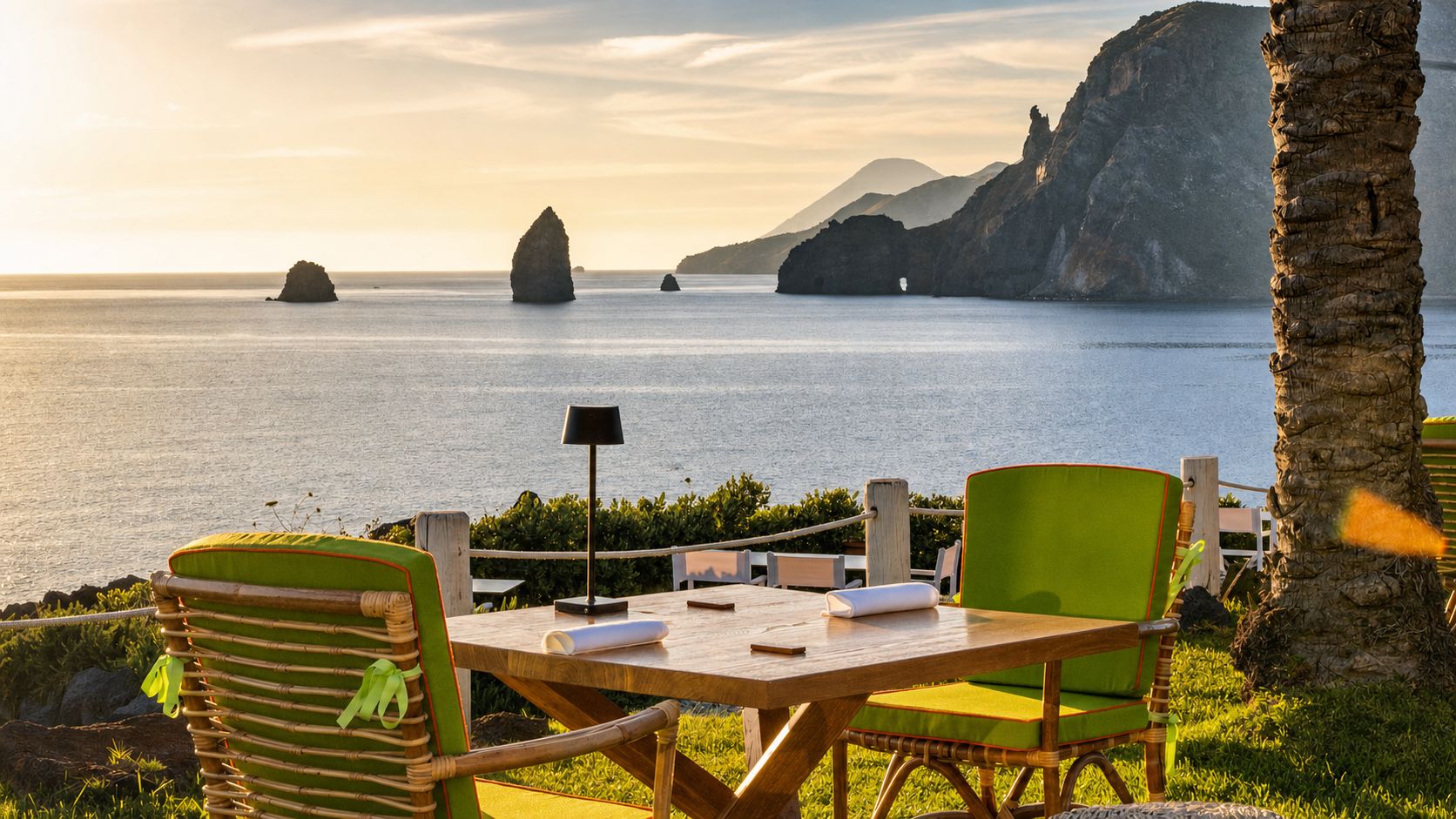
Why is the authority in travel in Greece talking to an Italian chef based in Italy? Because some ideas don’t respect borders: they travel like weather. Vegetable-first fine dining is the front sweeping across Europe right now, and Davide Guidara is its eye: the chef of I Tenerumi at the Therasia Resort, the only restaurant on the continent to hold two Michelin stars (plus a Green Star) for an exclusively plant-based menu, served in the open air above the Aeolian Sea with a near zero-waste conscience. His name already circulates in Athenian kitchens and Greek food writing the way a rumor does: quoted, borrowed, argued with. So for the food-loving traveler who has chosen Greece this year, and who will inevitably meet his influence on a plate in Sifnos (a foodie heaven island) or Pangrati (a gastronomy testbed area in central Athens), consider this your context.
One more thing, and it’s almost too perfect: I Tenerumi sits on Vulcano, one of the Aeolian Islands, seven volcanic specks off Sicily’s north coast, named after Aeolus, Homer’s keeper of the winds. Sun-bleached, wind-scoured, sea-locked: perhaps the closest thing to Greece the Mediterranean offers outside Greece itself. What follows is Guidara in his own words.
Curation & Adaptation: Nikos Kakavoulis
A carrot is a carrot
It took me nearly twenty years in kitchens to earn the right to say something that simple, and to understand how radical it is.
Fourteen
I started at fourteen, working Friday to Sunday at a neighborhood restaurant right below my house. I’m 32 now. That’s almost two decades in this industry. You don’t decide on a life like this. You just keep showing up until it’s yours.
I studied at a hospitality school in Castel Venere, my small hometown near Naples, in the province of Benevento. Every year, from June to October, I would leave school to do stages. School gives you the map. The internships give you the territory.
That’s how I ended up at Don Alfonso. Then Il Mosaico in Ischia, with its two Michelin stars. Le Terrazze in Rome. After graduating, Sea Grill in Brussels, two stars again. Then Michel Bras at L’Atelier in France. Then Noma. Then here. Every kitchen taught me something, but no kitchen told me who I was. That part you have to do alone.
Two Words
The manager of the Therasia Resort came to see me where I was working and said, almost instantly: “Why are you staying here? Come cook for my restaurant.”
I told him: I want to build an extraordinary restaurant, not an ordinary place. An open kitchen, right inside the dining room. And I want to cook exclusively vegetables.
His reaction was: “What? Are you crazy?”
I said two words: “Trust me.” And he did. I’ve learned that the biggest doors in life open on those two words, but only if you’re prepared to be crushed by them if you’re wrong.
Listen to the Compliment
There are two stories behind my decision to cook only plants. The first: when I was a chef elsewhere, guests and journalists kept telling me, “Your food is good. But your vegetables are unbelievable.” People will tell you who you are, if you listen to the compliment inside the compliment.
The second story matters more. When I told other chefs I wanted to open a vegetable-only restaurant, you cannot imagine how many tried to stop me. “Davide, you have so much talent. Why limit yourself? Michelin never pays attention to these restaurants. Stick to the safety of meat.”
The people who love your talent will often be the ones asking you to waste it. They don’t mean harm. They mean safety. It’s not the same thing.
The Manifesto
Everything begins with three words: cook more plants. I call what we do Vegetal Cuisine: not vegan, not vegetarian, a completely different approach. When people hear “vegan” or “vegetarian,” they imagine a commonplace of boring flavors. I want to destroy that idea.
In my dishes you see only the clean, pure expression of each ingredient. No foams. No superfluous elements. A cuisine of absolute essence. I’ve found this is true beyond the kitchen too: the moment you remove everything unnecessary, what remains starts to speak.
My Ferraris
The stereotype I most want to break is the idea that vegetables must be dressed up, transformed to mimic meat or fish to become worthy of a fine dining plate. Why tell people, “Look, this carrot tastes like beef”? That, to me, is crazy.
For most chefs, duck or pigeon is the Ferrari of the kitchen and the zucchini is a humble side. No. The zucchini, the tomato, the bell pepper: these are my Ferraris. They are equal to caviar. Nothing on earth is humble. Some things are just waiting for someone to take them seriously.
And if you ask me which vegetable the world has understood least: the zucchini, without a doubt. The perfect ingredient. How often do you meet it in a fine dining restaurant? Rarely, and then only raw or fried. Its potential goes so much further. The most underrated things are usually the ones sitting in plain sight.
The Pepper
Our most demanding process right now involves the red bell pepper. We char its skin with a powerful blowtorch. One second, and it’s black, while the flesh inside stays completely raw. We peel it under running water: a perfect pepper that has never actually cooked, that has lost nothing of its texture. Then we roast other peppers, extract their juice, cook the raw pepper in that concentrated juice, marinate it, dry it completely in a dehydrator, and when it’s time to serve, we rehydrate it in the roasted juice again.
A circular, complex process to arrive at the absolute essence of one flavor. Sometimes the longest possible road is the only way back to the beginning.
If You Handed Me Greece
If I had to make my own version of a famous Greek recipe, I’d choose tzatziki. Mine would have fermented yogurt for a deep, mature flavor, both fermented and fresh cucumbers, and garlic confit for a sweet, mellow aftertaste. A traditional recipe is not a museum piece. It’s an invitation.
And the Greek dish I find genuinely compelling is spanakopita. I love how comforting it is, and how the feta cuts through the herbs with a fresh, almost spicy note. The only thing I’d change is a bit more acidity, but that’s just me. I love acidity in food. Even the things you love should be allowed one honest criticism. That’s how you know the love is real.
The End of the Dinner
How do I change the way diners see vegetables? That’s decided at the end of the dinner. That’s when I know I’ve won the game.
In the first year, before the first star, people arrived skeptical. At reception they’d wonder: “Why only vegetables? Will I need a pizza afterward? Why would anyone open a restaurant like this?” After dinner, the same people would say: “Wow, I could easily become a vegetarian.” Now, with two stars, everything is different. You don’t win an argument with words. You win it with the last bite.
The Road
Everyone warned me I was choosing the difficult path. What they couldn’t know, what I couldn’t know either, is that the difficult path and my path were crossing the same road. That’s the secret nobody tells you: you only find out they’re the same if you refuse to turn around.

I Tenerumi
tenerumiristorante.it
Therasia Resort Sea & Spa, Vulcano, Sicily
+39 090 985 2555
Reservations: info@therasiaresort.it
Instagram | Facebook