


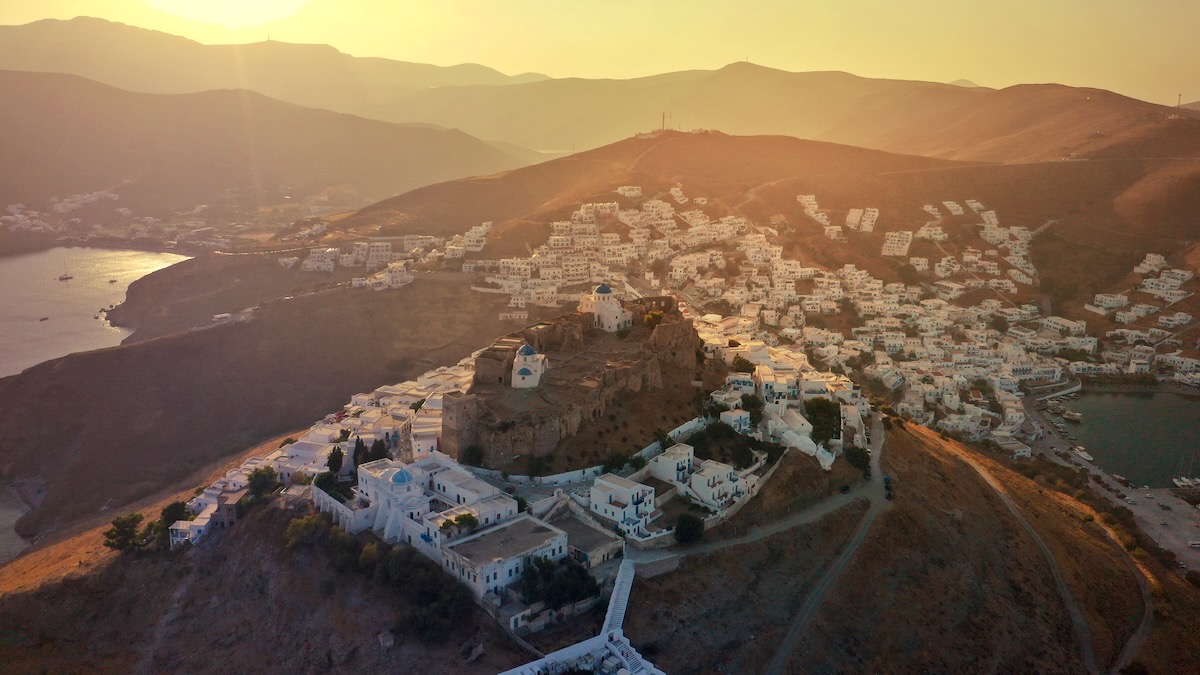
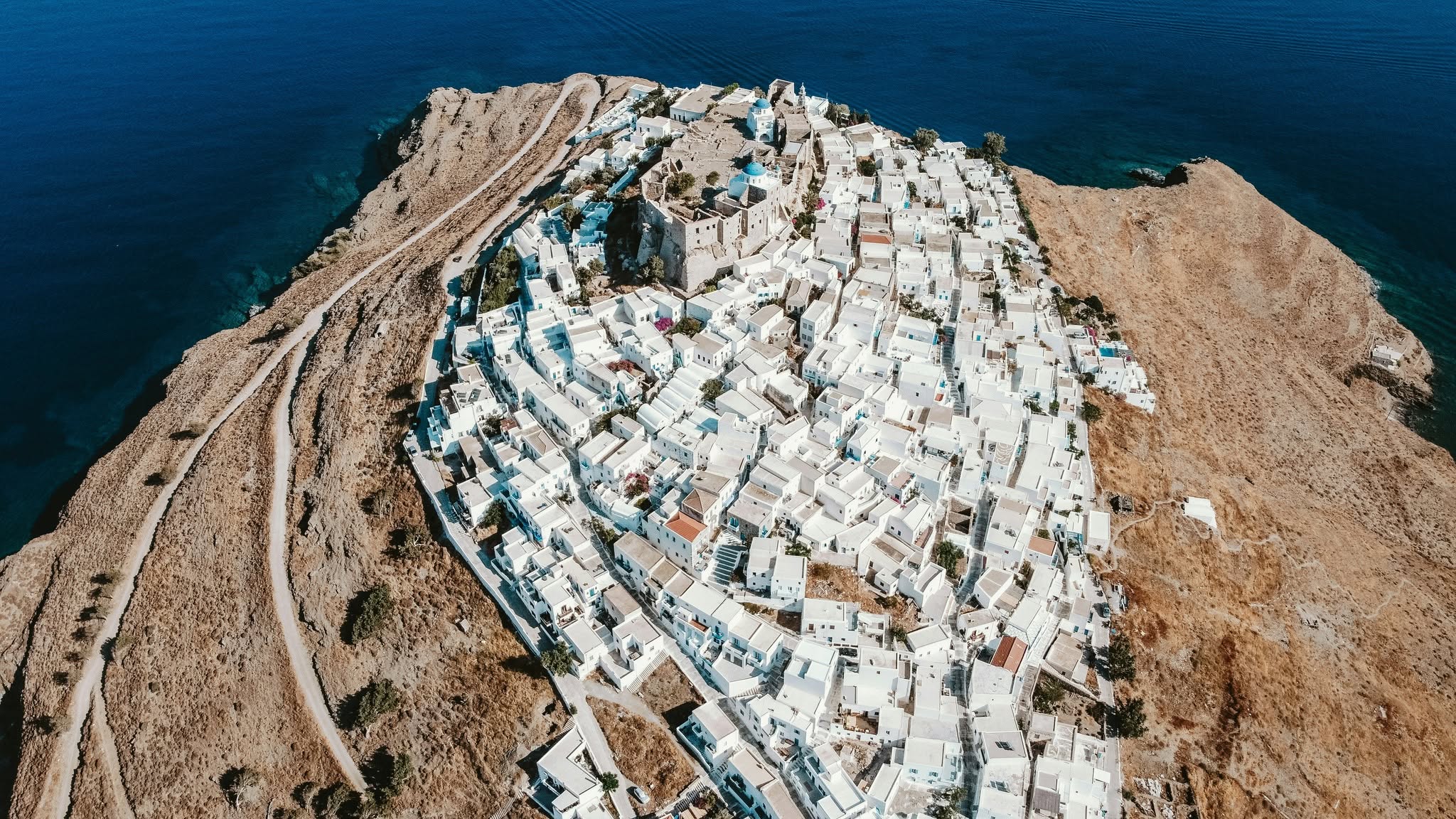
Astypalaia (read ‘Astypalea’) looks, at first, like a Cycladic island that has drifted east and has kept going. White houses climb toward a castle. Windmills stand on the ridge above Chora. The sea cuts into the island from several directions, leaving coves, bays, inlets, hard rock, tamarisk shade, and beaches that require more intention than impulse. From above, the island has the shape that gave it its most familiar nickname: the butterfly of the Aegean.
Administratively, Astypalaia belongs to the Dodecanese. Geographically and visually, it sits at the meeting point of two island worlds. Its whitewashed Chora, blue doors, limewashed lanes, and dry hillsides bring the Cyclades to mind, while its position, older history, and maritime connections place it firmly in the southeastern Aegean. That in-between quality explains much of the island’s character.
Astypalaia has become more visible in recent years, partly because of its smart-mobility project, partly because of the rise of better boutique accommodation, and partly because travelers looking beyond the standard Cycladic summer have begun to understand its appeal. Yet it remains a place that asks for some adjustment. Roads can be rough. Some beaches need a boat or a slow drive. The wind matters. The best tables and stays should be booked early. The pleasures are substantial, but they belong to travelers who enjoy a certain amount of friction with their beauty.
01
Geography & Identity: The Island Between Island Groups

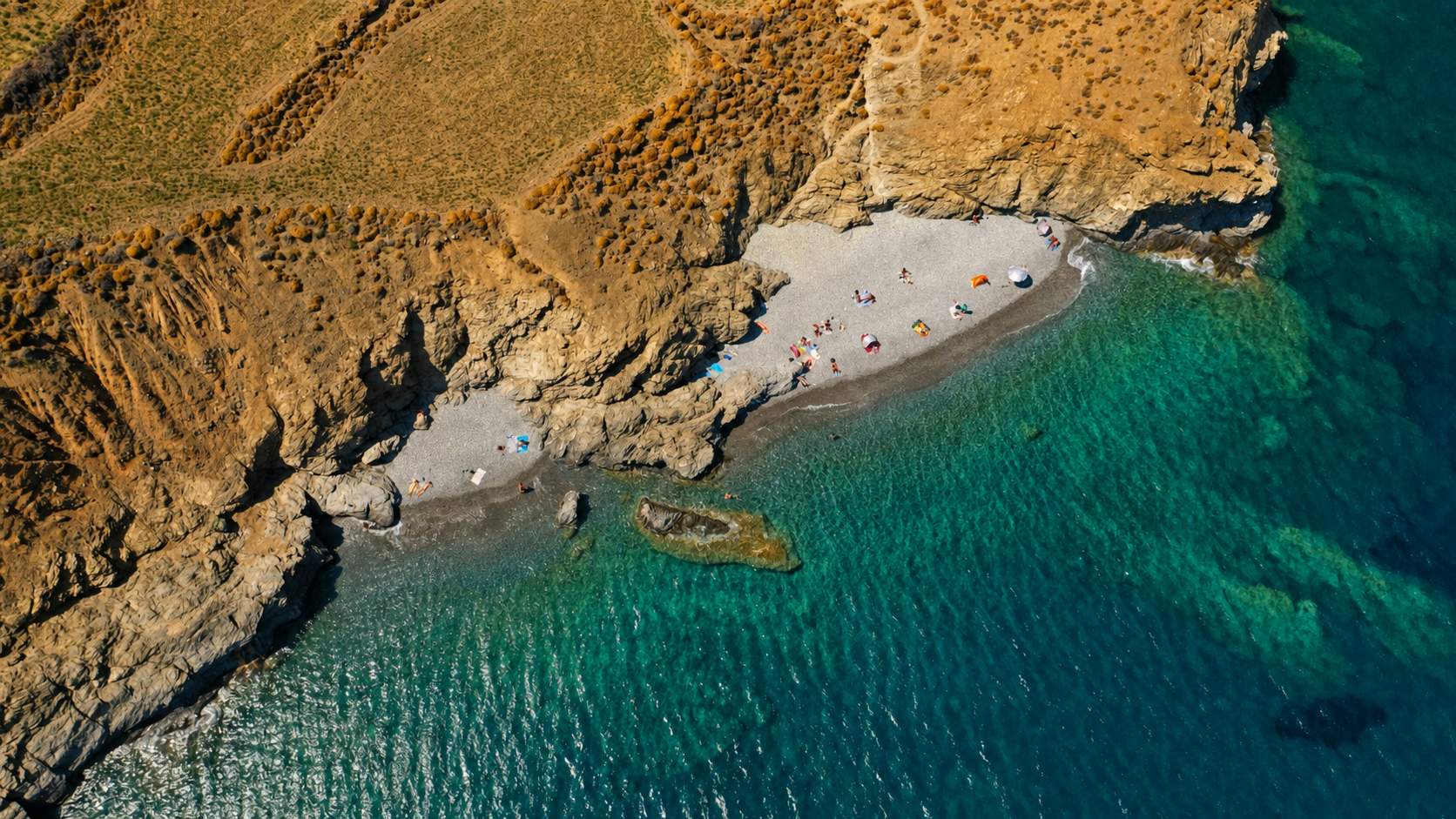
Astypalaia lies in the southeastern Aegean, west of the main Dodecanese chain and east of the Cyclades. Its two main sections, Mesa Nisi and Exo Nisi, are joined by a narrow strip of land, giving the island its butterfly shape. Chora occupies the western side, above Pera Gialos, the old port. Livadi lies below Chora, with one of the island’s most accessible beaches and a green valley by local standards. Further east, beyond the central isthmus, are Analipsi, also known as Maltezana, Schoinontas, and Vathy.
The island is small enough to get to know in a few days, but not so small that it can be experienced at once. Chora, Livadi, Maltezana, and Vathy each give a different version of local life. The surrounding islets, including Koutsomitis and Kounoupes, extend the experience by boat. The coastline changes constantly: organized beaches close to settlements, pebbly coves, rougher bays exposed to wind, and pale water around offshore sandbars.
Astypalaia’s position also gives it a useful distance from the more heavily rehearsed Greek-island summer. It has become fashionable, but it has not turned itself into a boutique stage set. Daily life still involves the port, the mills, the bakery, the beach road, the evening walk through Chora, the tavernas that fill fast, and the slow calculation of where the wind will allow a swim.
02
History & Heritage: The Castle, Churches & Old Settlement


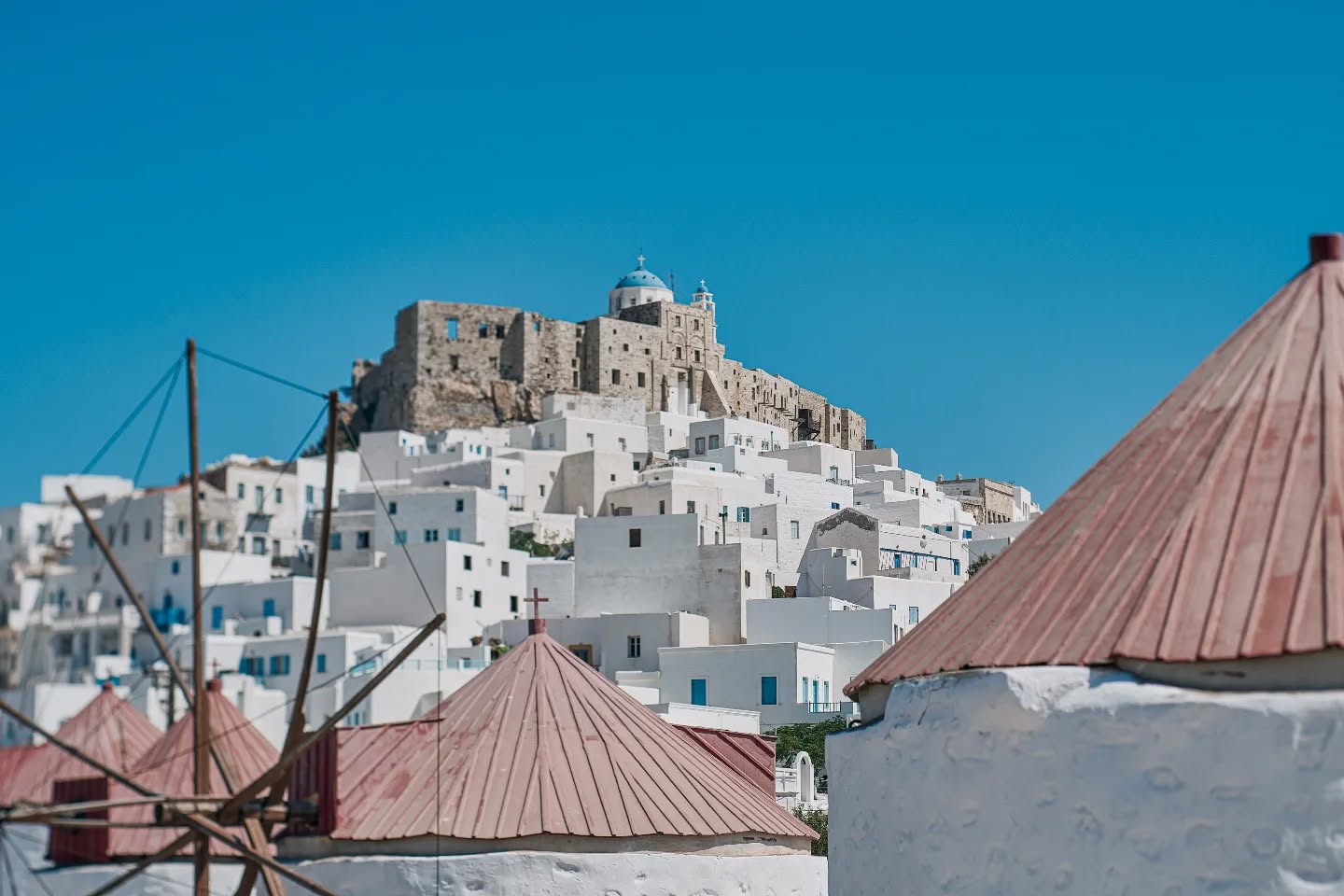
The island’s history reaches back to antiquity, but the most visible historical presence is the Querini, or Guerini, Castle above Chora. Built during Venetian rule, it occupies the natural high point of the settlement and gives Astypalaia one of its most memorable silhouettes. The castle walls enclose the churches of Panagia Evangelistria and Agios Georgios, whose white domes rise above the stone. From below, the structure appears almost fused with the houses that climb toward it.
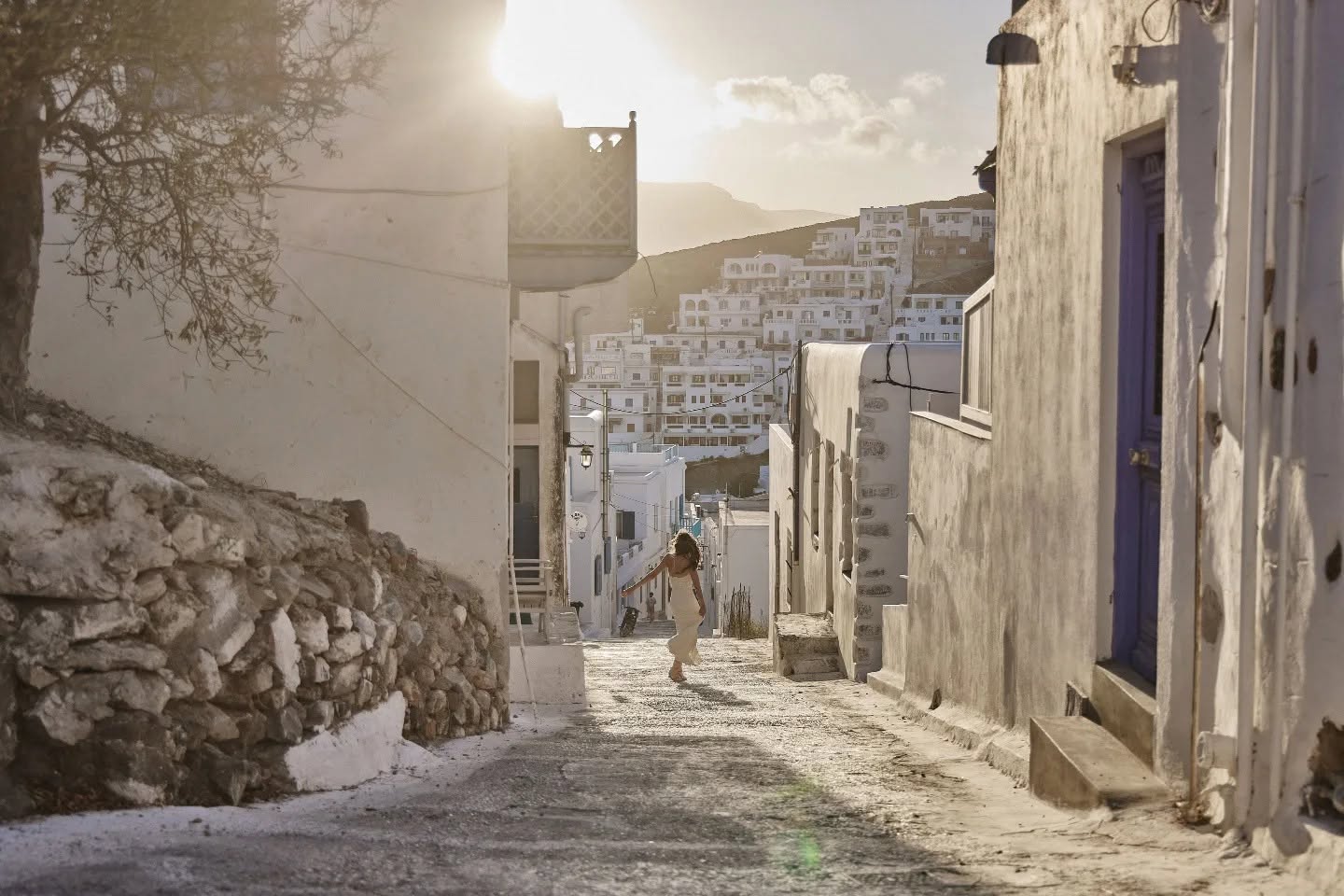
The old settlement around the castle deserves time on foot. Steps, arches, narrow passages, small terraces, courtyards, and white facades create a compact urban landscape shaped by defense, heat, wind, and the need to make use of steep ground. This is not a large museum island, but it has strong cultural markers: the castle, the churches, the windmills, the Archaeological Museum in Pera Gialos, and the small domestic details of Chora.
The Archaeological Museum gives useful context to the older island. Its exhibits include finds from different periods of Astypalaia’s history, from prehistoric material to later historical layers, and help connect the polished summer image of the island with its longer life in the Aegean. It is a sensible first stop before walking up through Chora, because the island’s beauty becomes more interesting when placed against its older settlement patterns, maritime routes, and religious traditions.
03
Chora & Landmarks: Windmills, Castle, and Evening Strolls
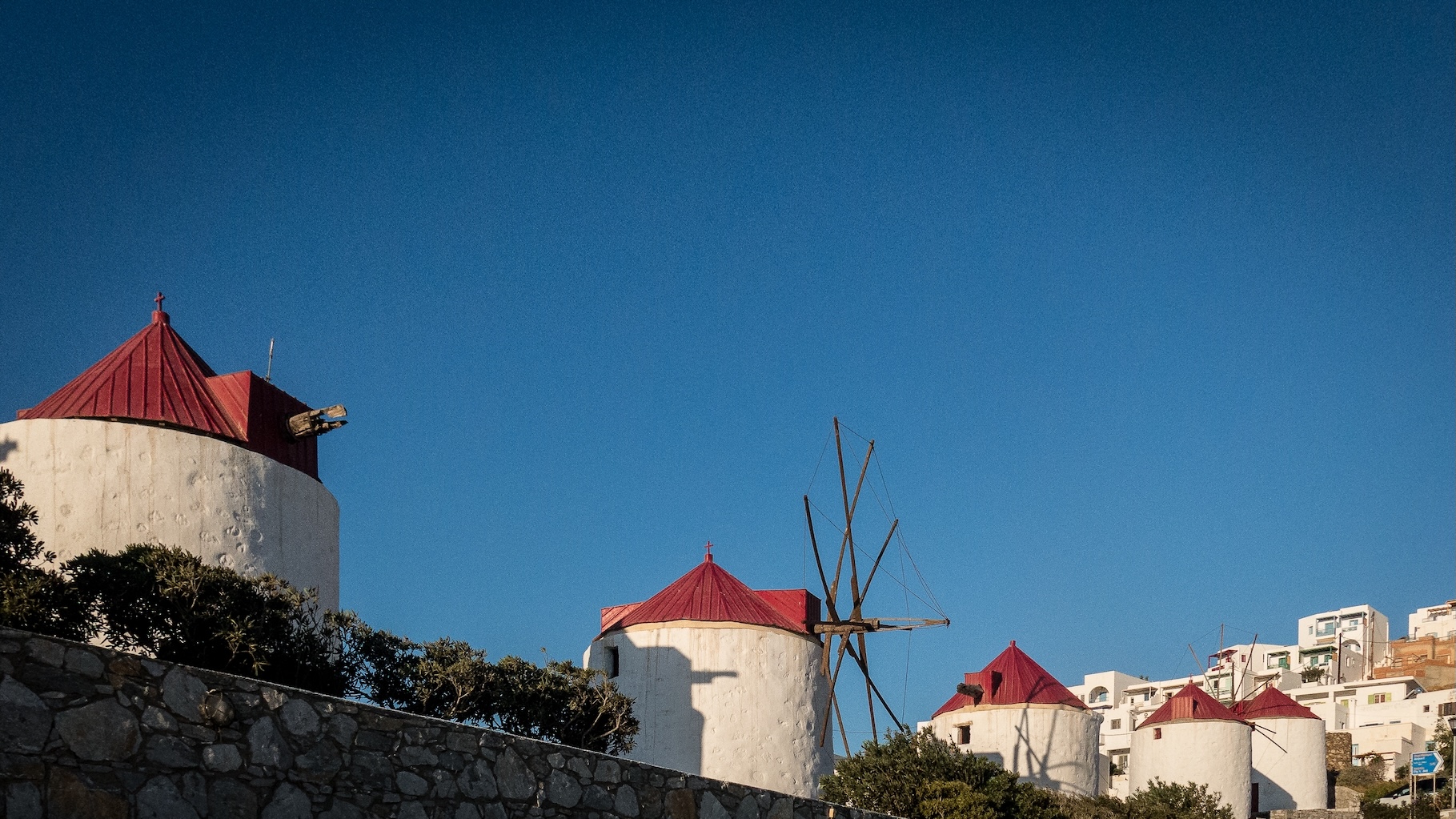

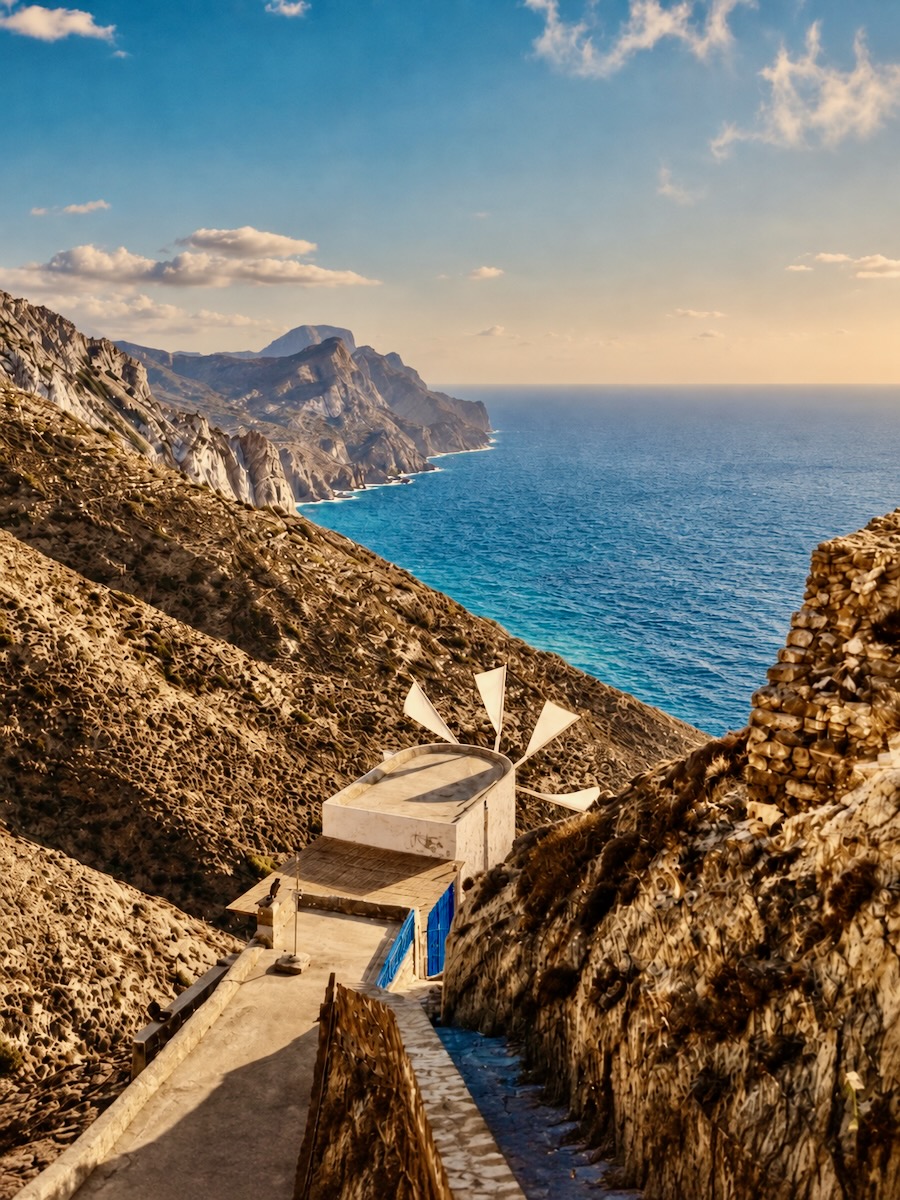
Chora is the island’s central stage. The settlement rises from Pera Gialos toward the castle in tiers of white houses, blue shutters, terraces, exterior staircases, chapels, and small squares. The line of windmills near the central square is one of the most photographed places on the island, but it also works as a practical reference point: from here, paths lead upward toward the castle, downward toward Pera Gialos, and outward toward bars, restaurants, shops, and sunset viewpoints.
The best time to walk Chora is late afternoon into evening. The climb is real, especially in heat, but the changes in view are constant. At the top, the castle gives a full sense of Astypalaia’s geography: Pera Gialos below, Livadi on the other side, the open Aegean beyond the houses, and the dry, folded land extending toward more remote beaches.
Pera Gialos, the old port below Chora, has a different character. It is lower, more practical, and useful for boat departures, casual food, and the beginning or end of a day on the water. Ferry operations may vary by season and port condition, with Agios Andreas normally serving as the newer ferry port while arrivals can shift to Skala or Pera Gialos when required. Before travel, check the exact arrival port on the ferry company’s current notice.
04
Culture & Community: Festivals and Cinema Nights
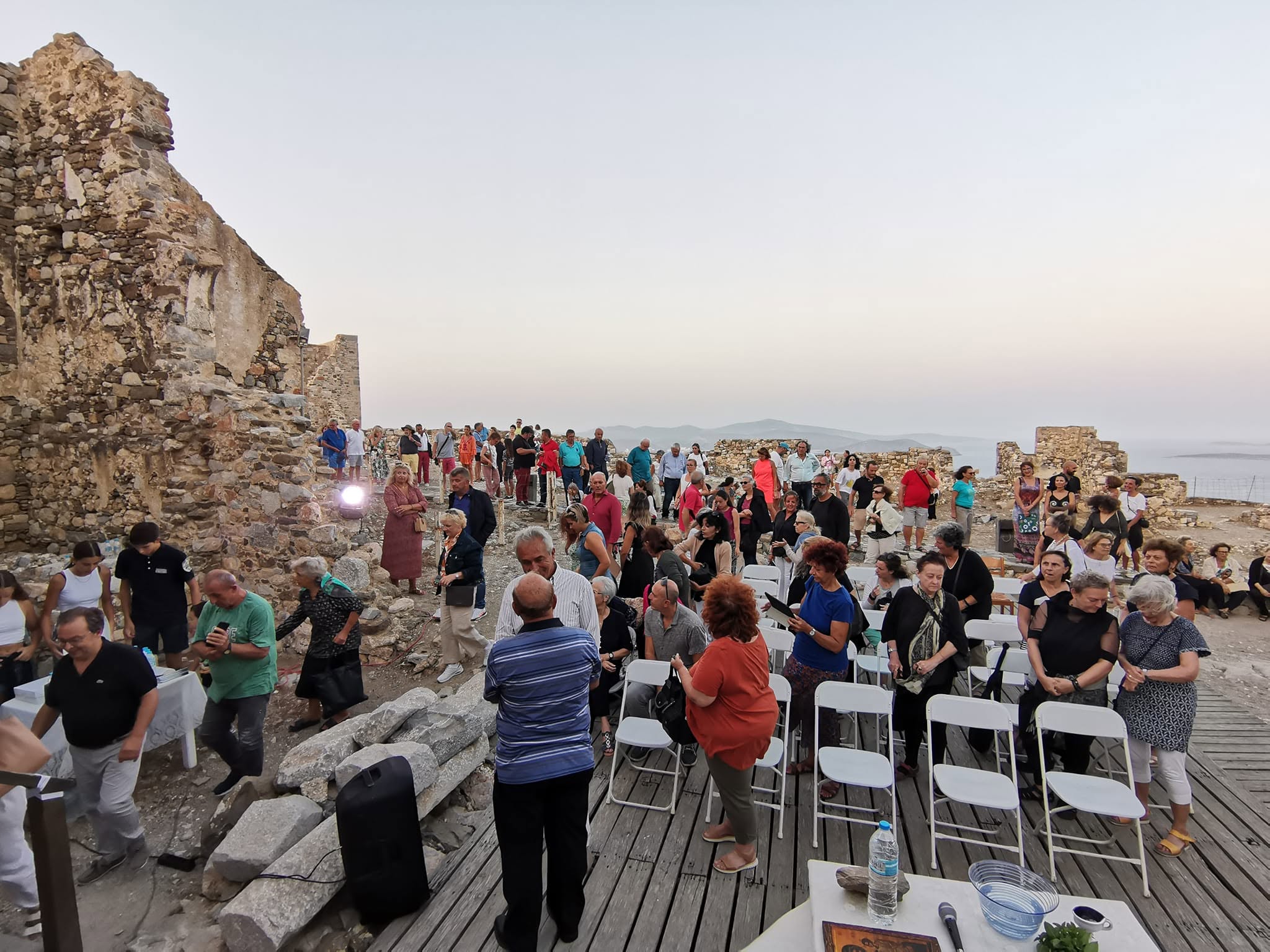

Astypalaia’s summer culture is built on religious feasts, local music, public gatherings, and a newer festival energy that has added a contemporary layer to the island. The major panigyria remain essential to understanding summer here. The calendar includes Prophet Elias on July 19, Agios Panteleimon on July 26, the Transfiguration on August 5, the Dormition on August 14 and 15, Agios Ioannis Prodromos on August 28, and Panagia Poulariani on September 7.
The most important feast is that of Panagia Portaitissa in mid-August. It is connected with one of the island’s most beloved churches, below the castle, and with the old forms of island hospitality: food prepared in quantity, local music, dancing, and a gathering that belongs to residents, returning families, and visitors who understand how to take part without turning it into spectacle. Lambriatis, the festive stuffed lamb or goat associated with Astypalaia, belongs naturally to this part of the island’s food culture.
Tsoula Festival, held July 4 to 12 in 2026, has added a livelier contemporary chapter. Its name comes from the tsoula, the traditional Astypalaian amulet once worn on the back of women’s dress as a protective symbol. The festival brings concerts, panigyria, screenings, talks, and cinema nights to different island locations. Astypalaia does not need a large cultural infrastructure to become interesting in summer. A square, a beach, a courtyard, a screen, a concert, and the right night are often enough.
05
Beaches & Boat Days: From Livadi Ease to Koutsomitis Blue
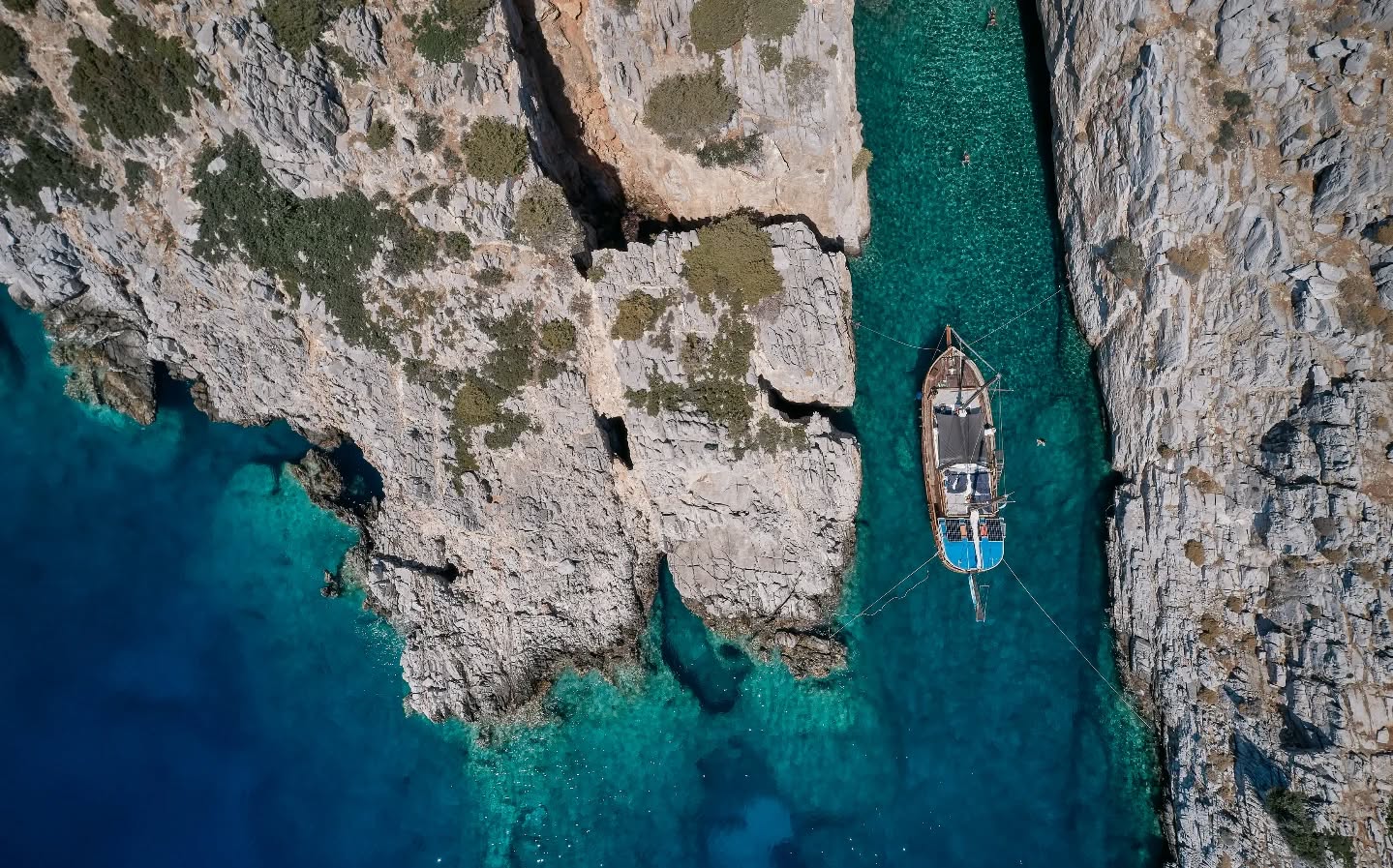

Astypalaia has beaches for different temperaments, and the distinction matters. Livadi is the easy one: close to Chora, organized, protected in many wind conditions, and lined with cafés, tavernas, rooms, and beach infrastructure. It is the obvious first swim and a practical base for anyone who wants the sea close without giving up access to Chora.
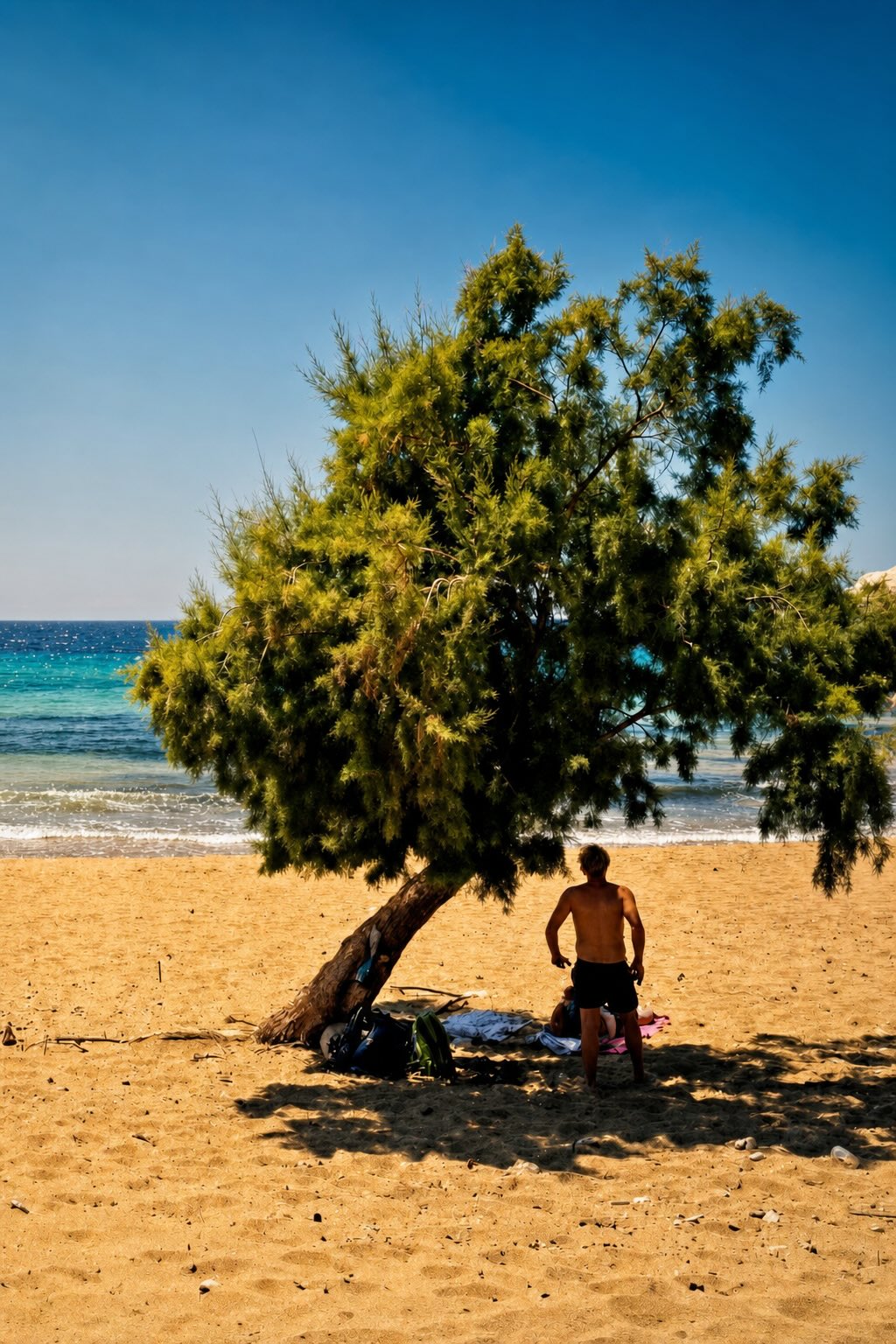
Agios Konstantinos lies south of Chora, reached by road with a final dirt section, and has one of the island’s best views back toward the castle. The beach is pebbly, with deep clear water, tamarisk shade, a chapel, and usually, seasonal food or beach service.
Tzanakia, beyond Livadi, is less developed and better for clear-water swimming with a view back toward the castle, though shade is limited. Agios Konstantinos is organized, with tavernas nearby and one of the most rewarding views of Chora from the water. It works well for a full beach day without abandoning basic comfort.
Vatses is more rugged. The road includes a long dirt section, and the beach is exposed depending on wind direction, but it has a stronger sense of arrival. Seasonal beach-bar service has operated there in recent summers, though 2026 operation should be checked before relying on it. The broader setting remains relatively raw: pebbles, tamarisks, dry hills, and open sea.
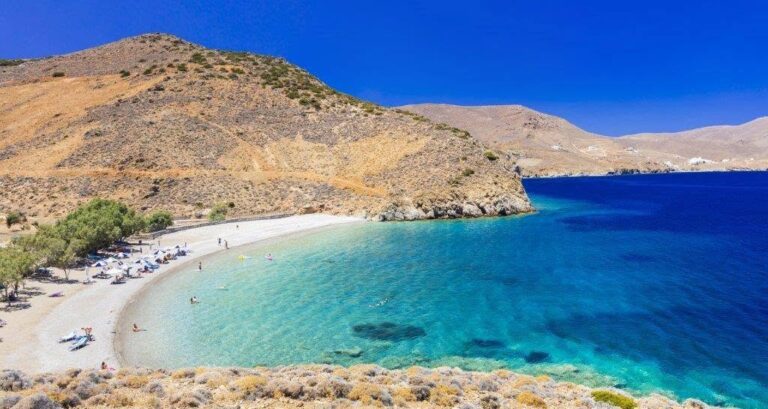

On the road from Chora toward Maltezana, Plakes is reachable via a short path that leads down from the road, where the choice is between a pebbly section and the flat rock slabs that give the beach its name. The water is deep, clear, and good for mask-and-snorkel exploration, with no shade or facilities, so it works best as a morning or late-afternoon swim
Kaminakia is one of the island’s most popular longer excursions, reached by dirt road or boat, with tavernas near the beach and a more settled summer rhythm than the route might suggest. Agios Ioannis is more remote and requires a rougher approach, but it rewards the effort with clear water, rock, and a stronger sense of distance from Chora.
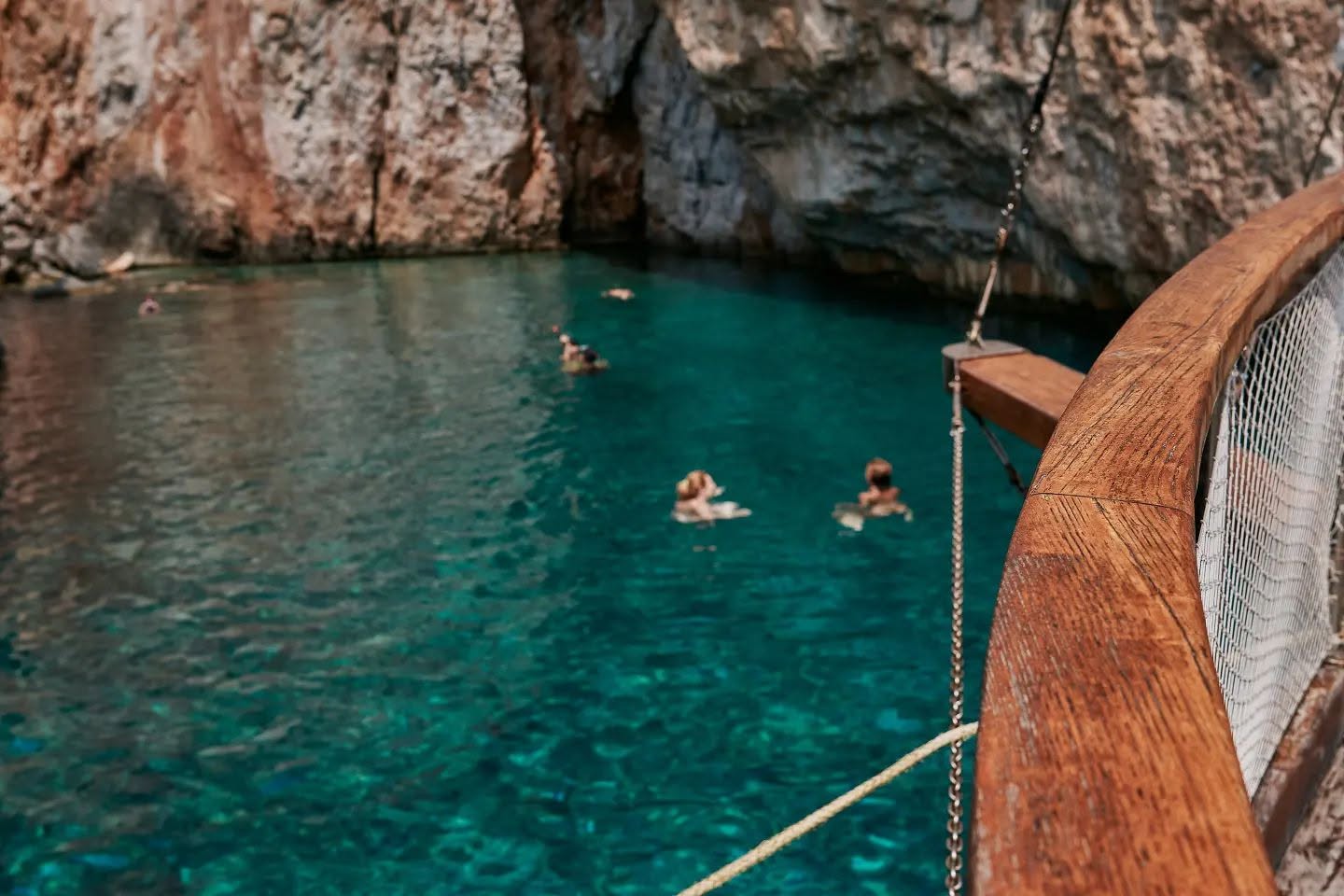
Koutsomitis is reached by boat and is one of Astypalaia’s essential swimming excursions, with shallow, luminous water, pale sand, and the feeling of being temporarily removed from the main island. The trip is best planned according to wind and sea conditions, often combined with Kounoupes and nearby islets for a full day of swimming.
The boat trips are central to the island. Koutsomitis and Kounoupes are the names to know: pale water, small-island swimming, and the kind of Aegean blue that justifies the day at sea. Boats also run to beaches such as Vatses, Agios Ioannis, and Kaminakia in summer, depending on weather and local schedules. On Astypalaia, a good beach day begins with the wind. Asking locally is the difference between a difficult outing and an excellent one. Some cruise trip companies to contact are Infinity Sea Cruises, Perla, and Avra Cruises.
06
Villages & Small Settlements: Livadi, Maltezana, and Vathy
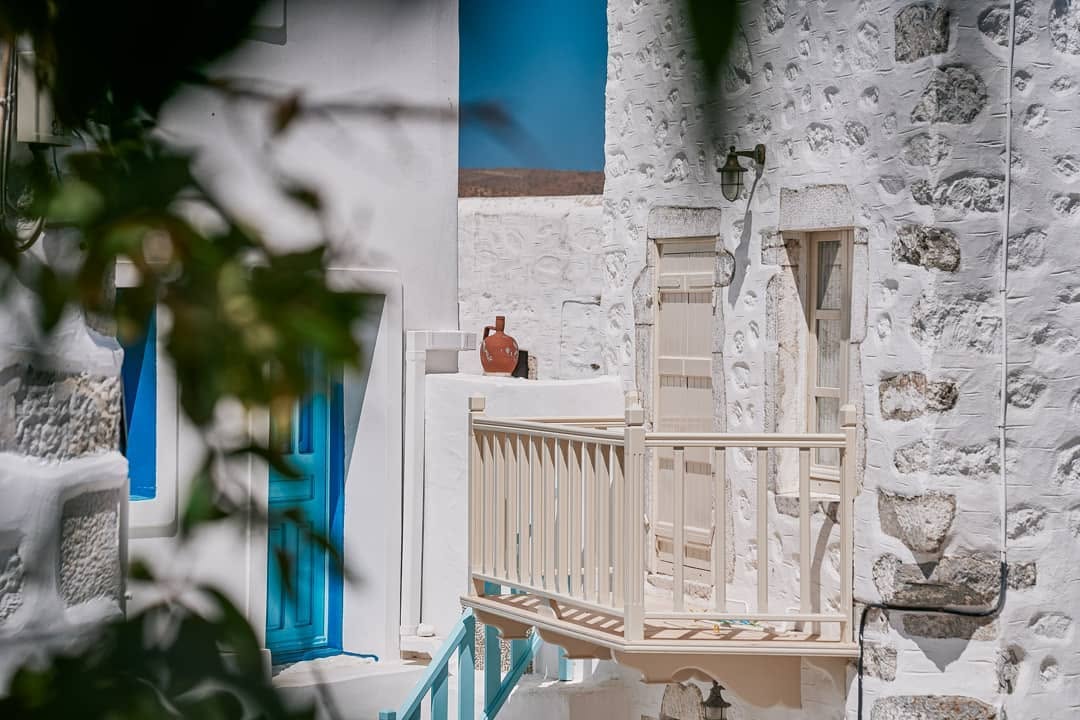
Livadi sits below Chora in a fertile valley, with orchards, rooms, tavernas, and one of the island’s most practical beaches. It suits travelers who want to swim before breakfast, return from the beach without a long drive, and still reach Chora easily in the evening. Its beach is organized, accessible, and useful during windy days, which gives it real value in August.
Maltezana, also called Analipsi, lies on the eastern side of the island and has a calmer, seaside-village quality. It is associated with lower-key summer stays, family-run restaurants, small beaches, and a gentler pace than Chora. Schoinontas, nearby, has fish tavernas and beach life with an eastern-island feel. This part of Astypalaia is a good choice for travelers who want to sleep close to the sea and visit Chora rather than stay in it.
Vathy is more remote and more unusual. Set around a narrow, almost lagoon-like bay on Exo Nisi, it requires a longer drive and a willingness to move beyond the obvious routes. It has fishing-village character, sparse development, and access to the Dragon’s Cave by boat when conditions allow. It is one of the places that reminds visitors that Astypalaia is not only its castle view and white Chora.
07
Nature, Trails & Low-Impact Ways to Explore
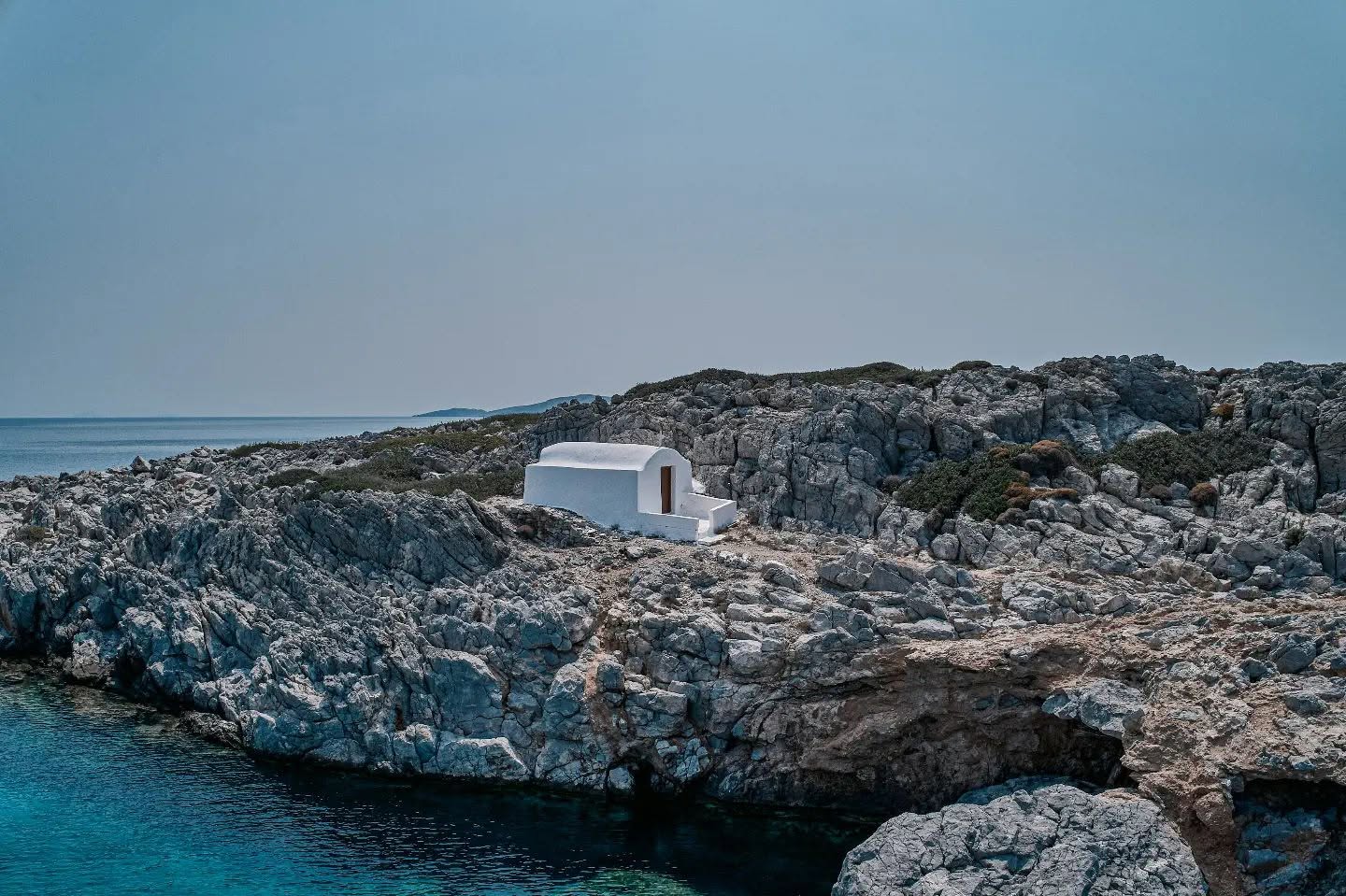

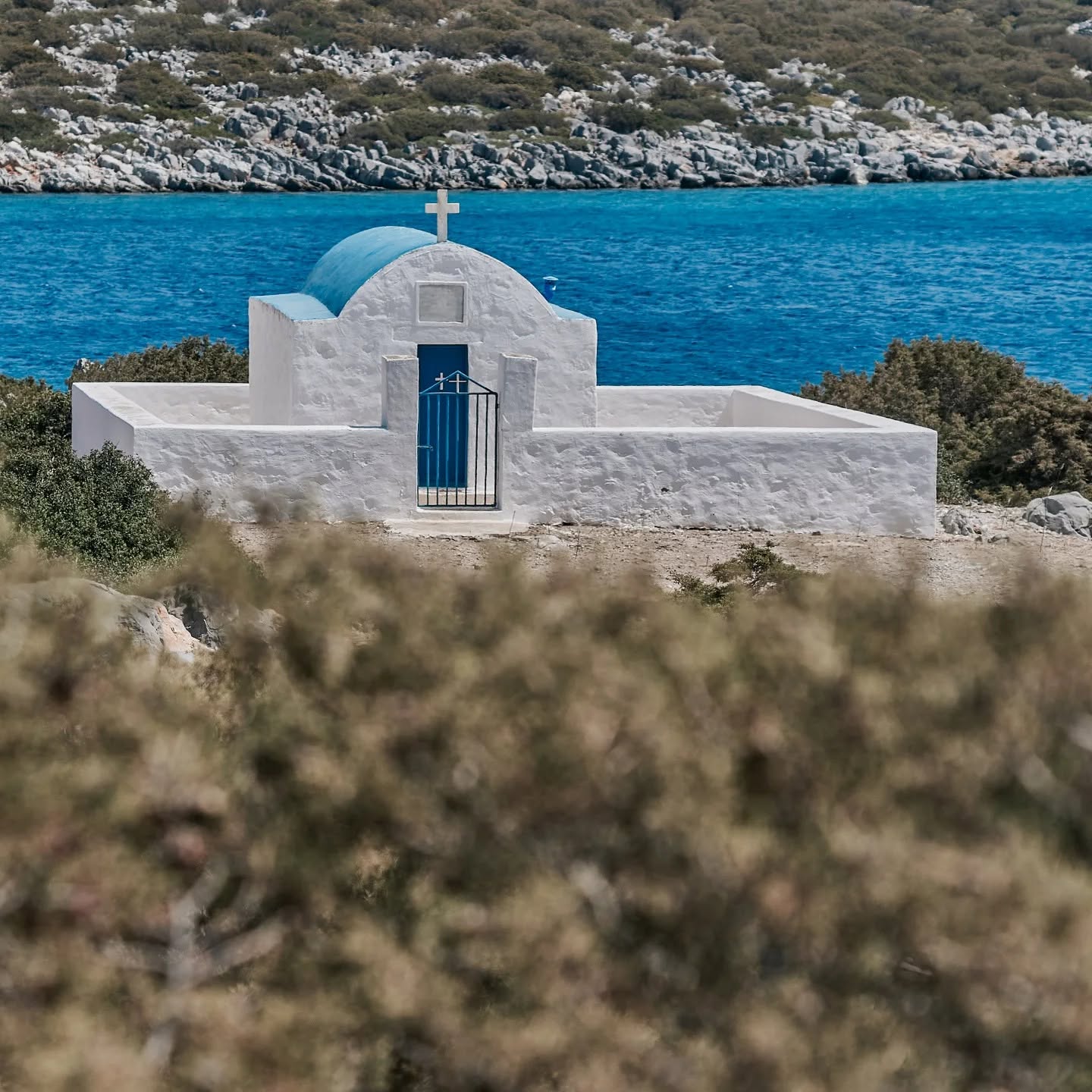
Astypalaia’s landscape is dry, open, and exposed, with low vegetation, stone, hills, small chapels, and roads that lead from settlement to rougher coast. Walking is best early in the morning or late in the day, and the island rewards simple movement: the climb through Chora, the approach to the castle, coastal walks near Livadi and Tzanakia, routes toward chapels, and short explorations around beaches and viewpoints. Heat and wind should be taken seriously. Proper shoes and water are necessary outside the settlements.
The island’s caves and boat-access points add another layer to its natural geography. The Dragon’s Cave near Vathy, known for its stalactites and stalagmites, is reached by boat when the sea permits. Around Koutsomitis, Kounoupes, and the smaller islets, the sea becomes the main route into the landscape. Astypalaia is not an island for passive beach collecting alone. Its best natural experiences usually require a bit of timing, local advice, and adjustment to the day’s conditions.
This is also where the island’s mobility experiment enters daily travel in a useful way. ASTYBUS, the on-demand transport service, and astyGO electric vehicle sharing give visitors alternatives to using a conventional rental car for every movement between Chora, Livadi, Maltezana, the port, and selected routes. Charging points and electric vehicles have become part of the island’s visible infrastructure. The point is not to treat Astypalaia as a completed eco-utopia. It is more interesting as a working island where visitors can use shared and electric mobility for ordinary summer needs: dinner in Chora, a beach transfer, a port arrival, or a night out without another car on the road.
08
Gastronomy: Island Cooking & Restaurants
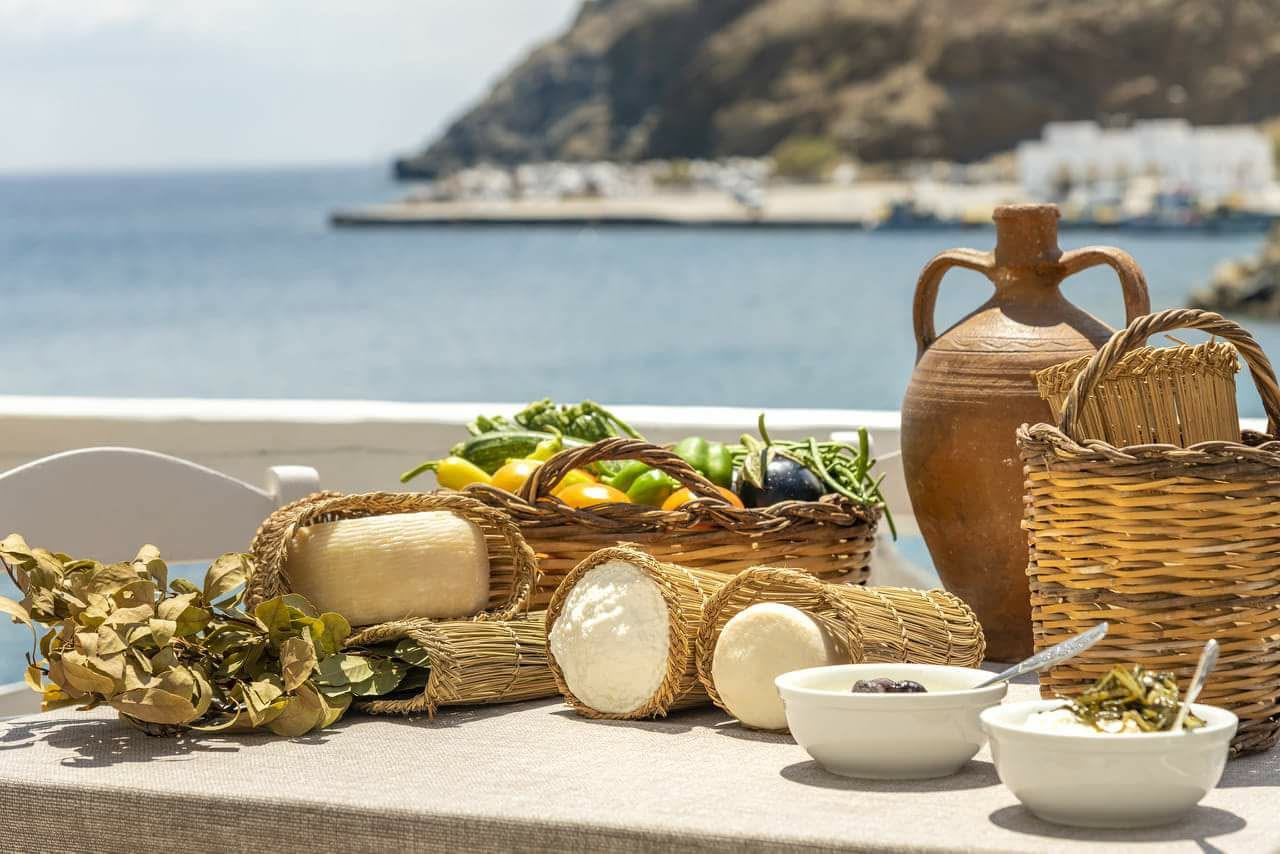
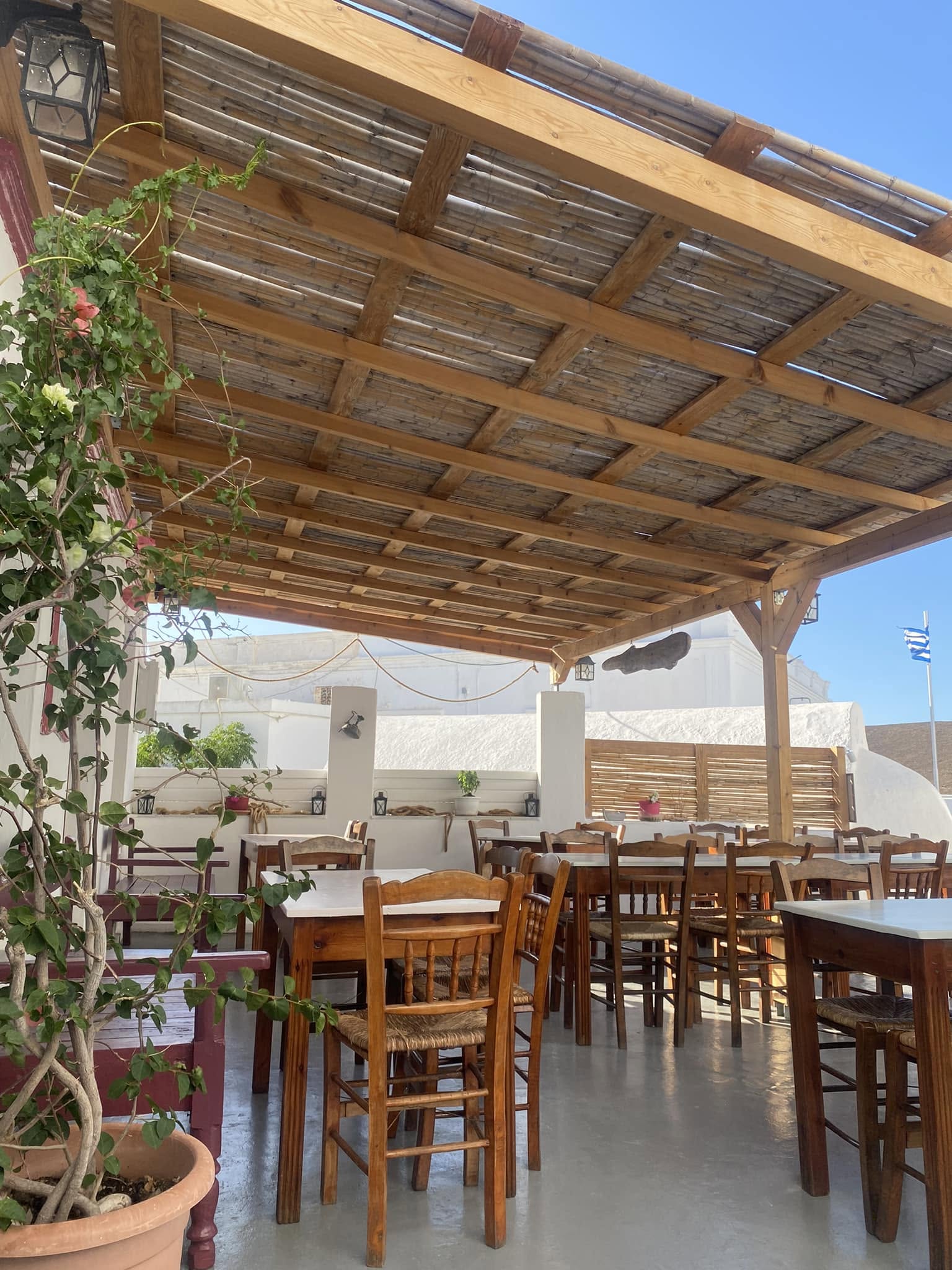
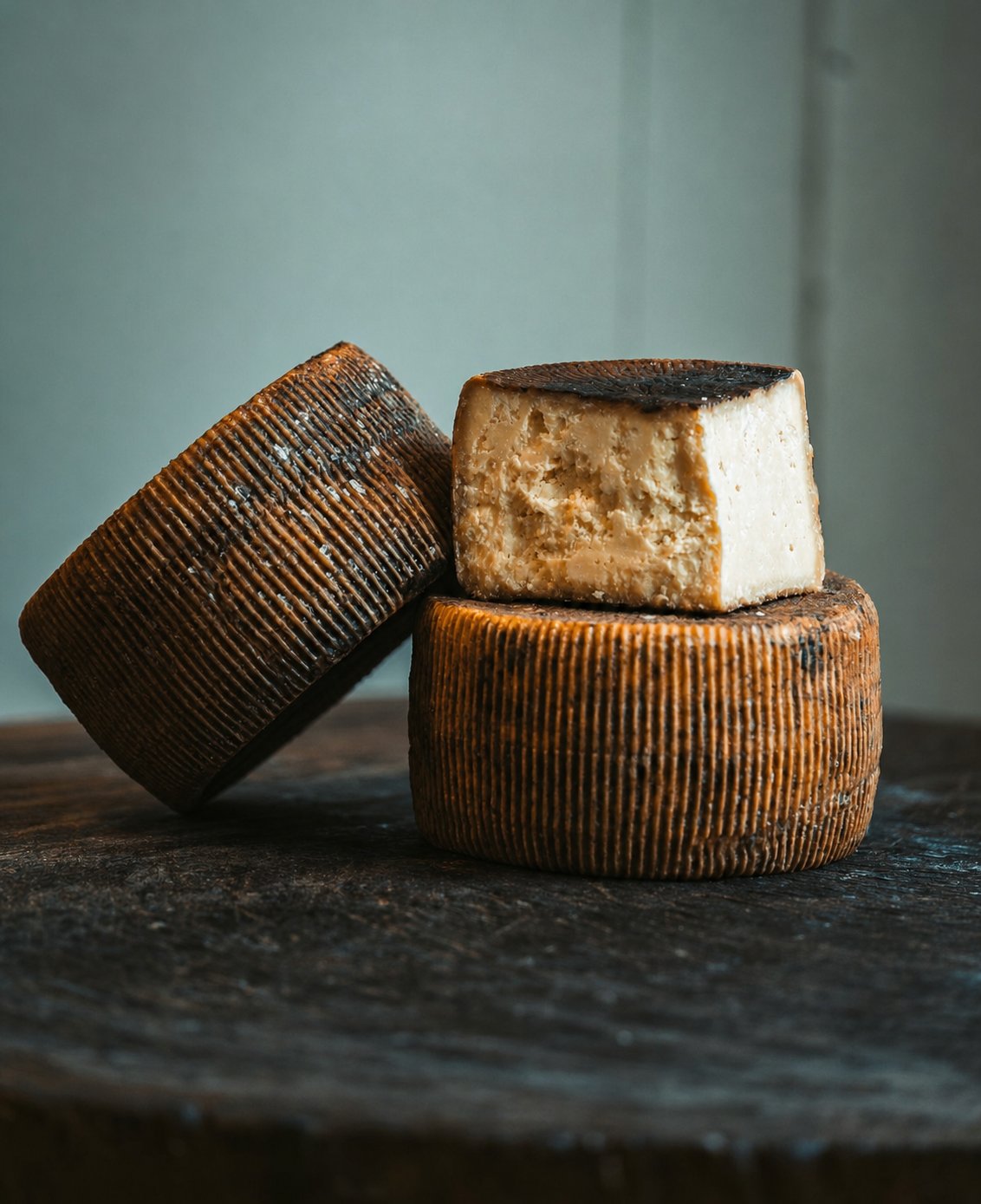
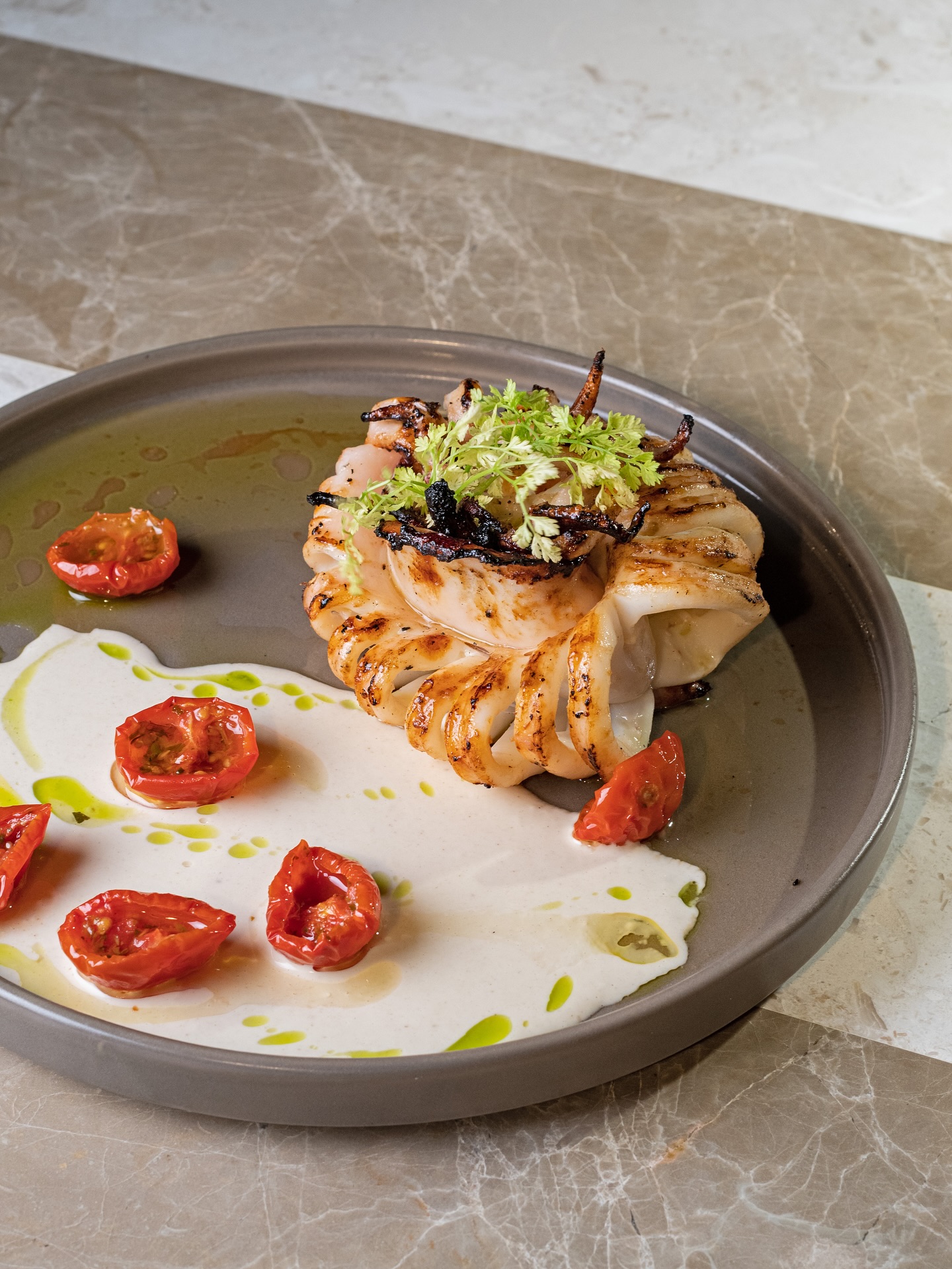
Astypalaia’s cooking has enough local identity to stand apart from the usual island menu. Look for chlori, the island’s fresh goat’s-milk cheese; poungia, small pastries filled with mizithra, cinnamon, and honey; kitsikakia, young goat with olive oil, lemon, and oregano; lambriatis, slow-cooked stuffed lamb or goat; onion pie; local honey; seafood; and simple fish tavernas. Xirotigana, honeyed fried pastry ribbons, appear at celebrations and in traditional sweet making, while petoura, the island’s local pasta, turns up in more substantial seafood dishes.
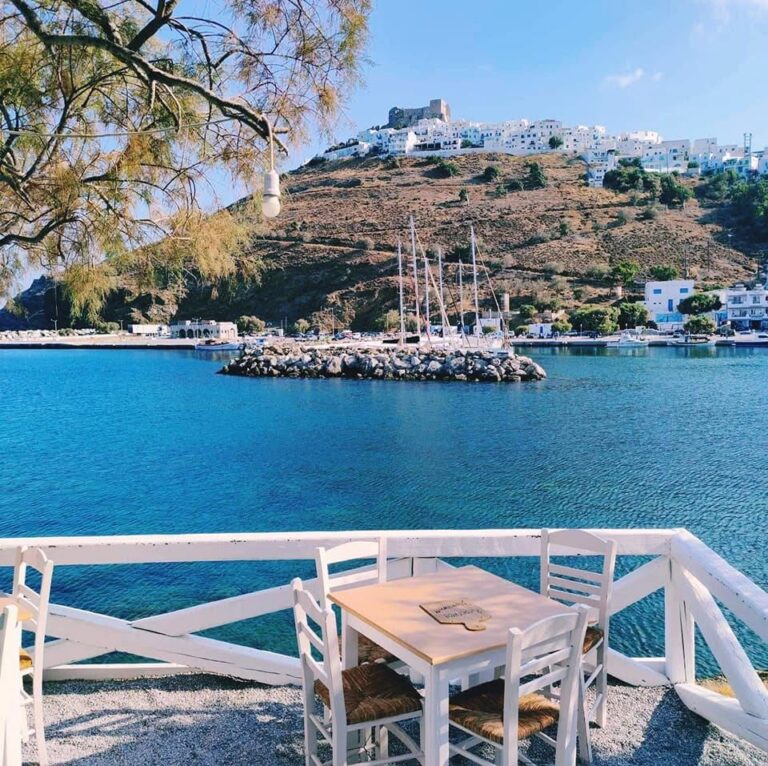
In Pera Gialos, Akti Restaurant occupies one of the island’s most dramatic dining positions, built into the rock in several levels, with balcony-like terraces looking toward the sea and Chora. The Petridis family opened the restaurant in 1980, and the current version has been renovated with a spare, white, maritime look. The kitchen is centered on fish and seafood, with fish soup, seafood risotto with bisque, lobster pasta made with petoura, fresh local fish fillets, fava with caper stew, tarama in three versions, classic summer meze, and chlori served with extra-virgin olive oil.
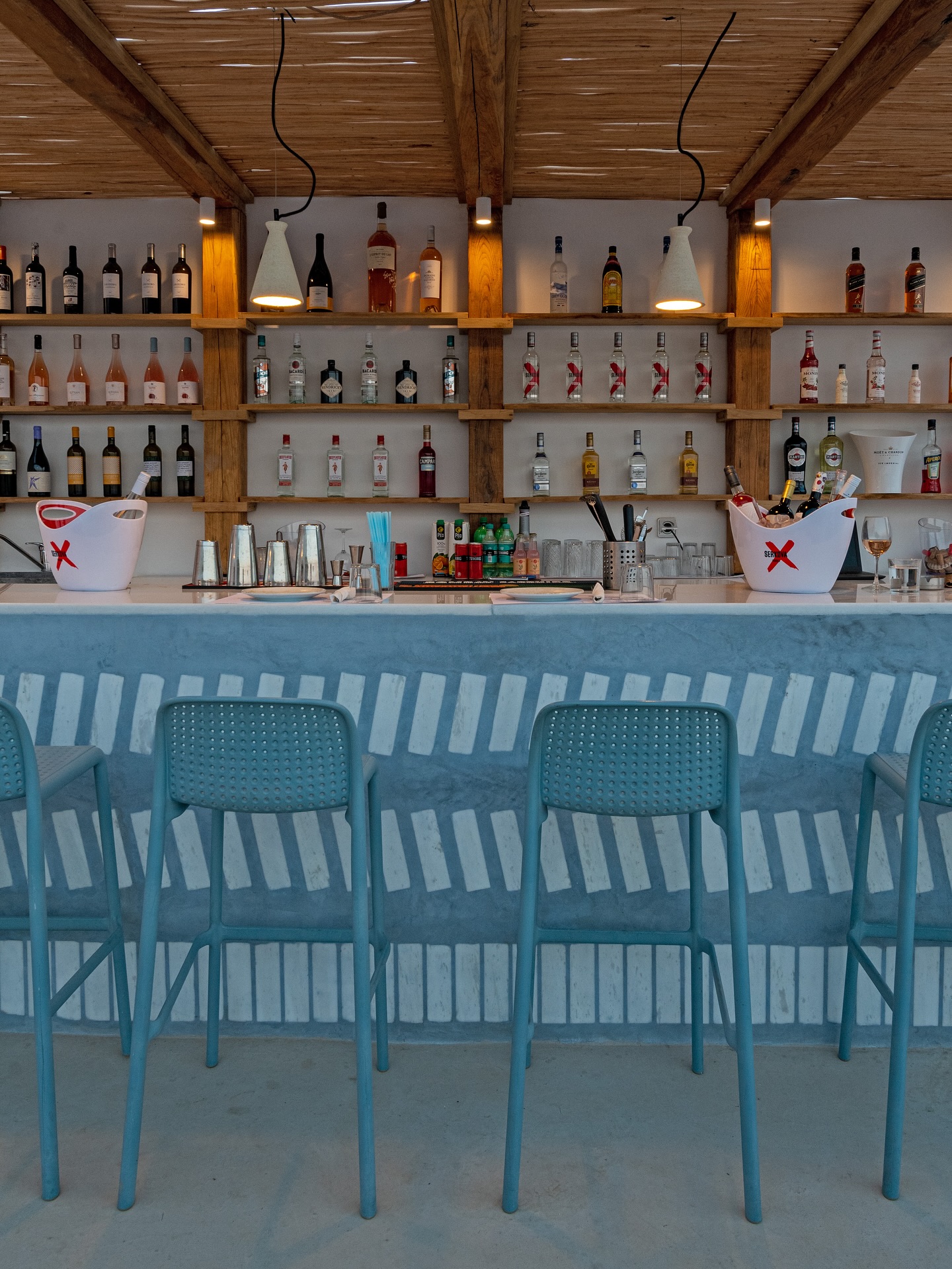
In Chora, Barbarossa sits above the Town Hall and works as a more urban evening address. The setting combines wood, glass, views, and a wine-bar feel, with a menu that moves between local cooking and more contemporary Greek dishes. Astypalaian octopus, eggplant rice, moussaka, seafood, and a strawberry salad are among the dishes associated with the restaurant, making it a useful choice for dinner in Chora when the evening is not built around the waterfront.
Antikastro, in Pera Gialos, has the advantage of a courtyard and a view toward the castle. The cooking is traditional, with zucchini fritters, shrimp saganaki, grilled dishes, local meat, vegetables, dolmadakia, and local cheese among the kinds of dishes to expect. It belongs to the straightforward taverna side of the island’s food scene, especially for an easy meal with the castle in sight.
Para thin Alos, on Livadi beach, is a family-run seaside restaurant with an open terrace and a direct view toward the water and the castle. The menu combines seafood, meat, pulses, grilled dishes, pasta, fish, lobster, prawns, octopus, and simple Greek taverna cooking, making it a practical address for travelers staying in Livadi or returning from the beach without wanting to climb back to Chora for dinner.
Astypalaia also has enough nightlife for a drink without turning into a party island. In Chora, the bars around the windmills and castle-view lanes fill after dinner, while Livadi and Pera Gialos keep the slower seaside rhythm.
09
Where to Stay: Views, Ease and Small-Scale Luxury

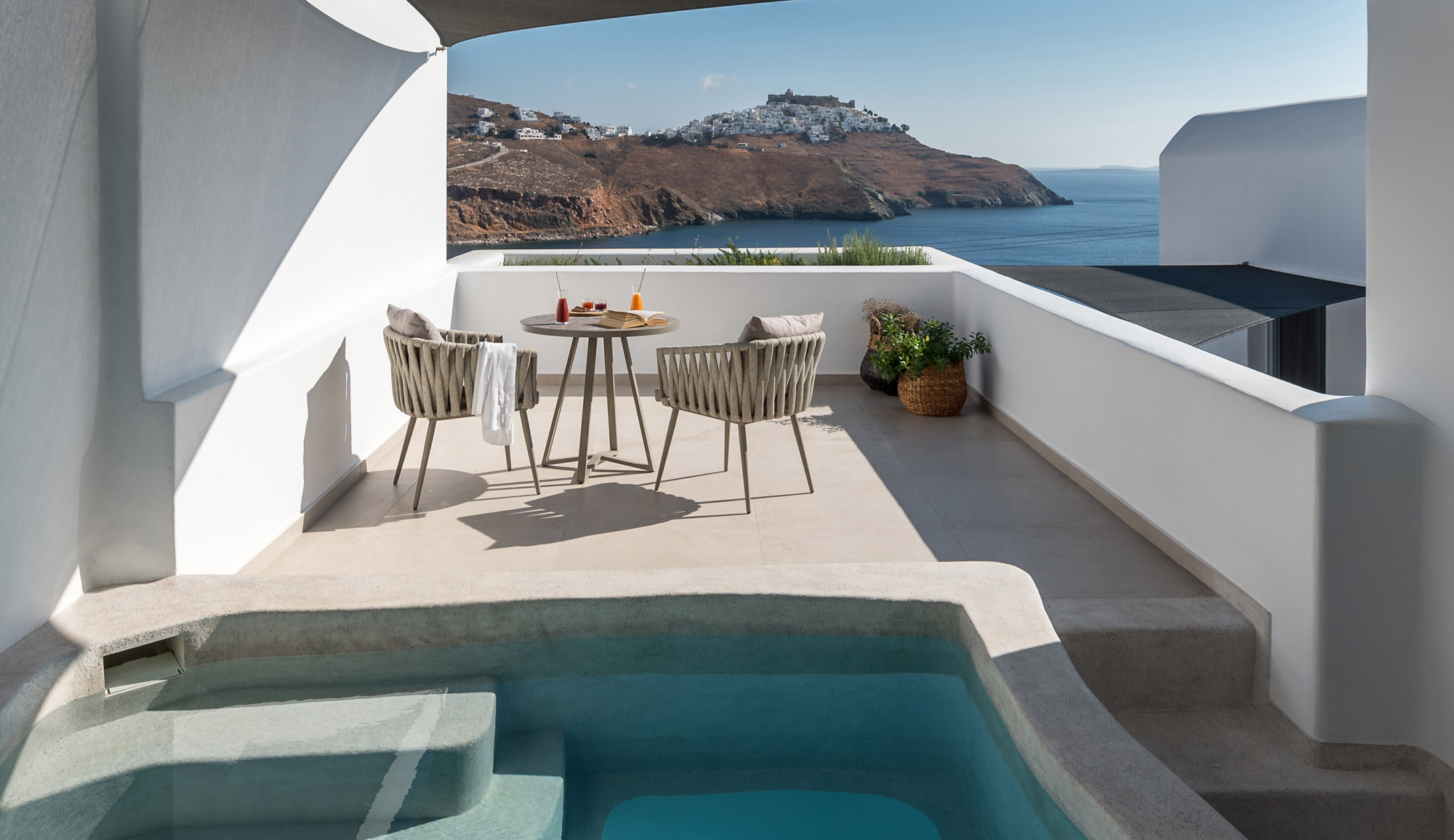
The best place to stay depends on how the day should begin and end. Chora is the choice for evenings on foot, castle views, restaurants, bars, shops, and the full visual drama of the island. It is also steep, busy in high summer, and not always practical for travelers who want the beach immediately outside the door. Livadi is better for easy swimming and a softer daily routine below Chora. Maltezana and Schoinontas suit quieter seaside stays, especially for travelers who prefer village scale and do not need to be in Chora every night.
Kallichoron Art Boutique Hotel, in Chora, is one of the island’s most established boutique stays, with an eco-conscious profile, art elements, views, and a breakfast identity built around local products. Tholaria Boutique Hotel, close to the windmills and central square, offers castle and sea views, a pool, and easy access to Chora’s evening life. Pylaia Boutique Hotel & Spa is another Chora-area option for travelers who want spa facilities and a more hotel-like stay.
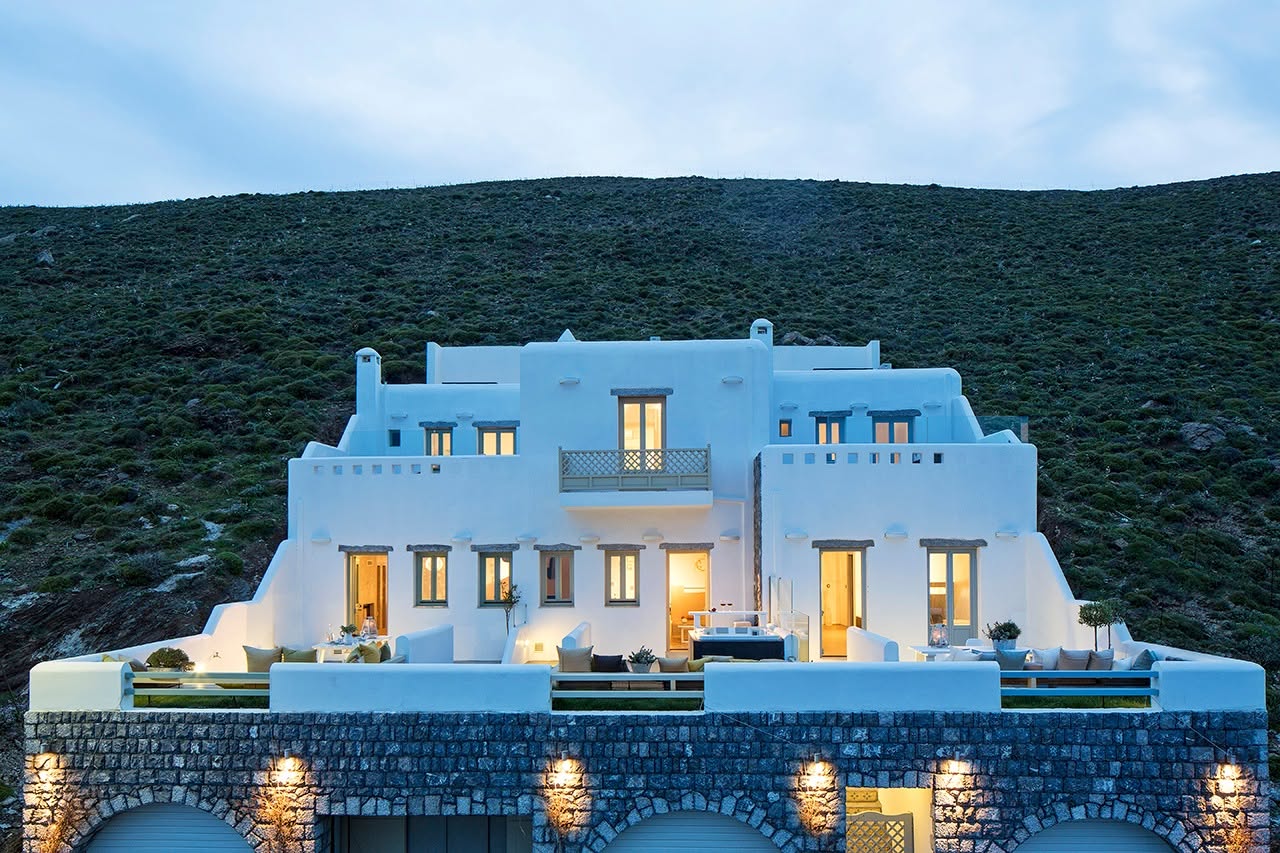
Saluti Da Stampalia Suites, near Livadi, belongs to the island’s more private upper-budget category, with suites and a stronger sense of retreat close to the beach. Melograno Villas and similar villa-style properties work for travelers who want space, privacy, kitchens, terraces, and the ability to settle in for a longer stay. Good-value studios and family-run apartments remain important on Astypalaia, especially in Livadi, Pera Gialos, and Maltezana, where simple, well-kept accommodation can be a better fit than a more styled hotel.
The island’s accommodation supply is limited. The best places are often small, and August availability can disappear months earlier. Location matters more than amenities: a beautiful suite far from the evening walk may require transport every night, while a simpler stay in Chora or Livadi can make the island feel easier.
10
How to Get There & How to Move Around
Astypalaia has a small airport, with flights from Athens depending on the season and schedule. The flight is short, but aircraft capacity is limited, so summer seats should be booked early. Ferries connect the island with Piraeus and other Aegean islands, with journey times varying by route, vessel, and season. Blue Star Ferries serves the Piraeus connection, while Dodekanisos Seaways links Astypalaia with parts of the Dodecanese network. Schedules change, and the island is not a place for last-minute assumptions.
Ferries usually connect through Agios Andreas, the newer port, though port changes can occur. Blue Star has recently announced temporary approaches to Skala or Pera Gialos because of a problem at Agios Andreas, so the exact arrival point should be checked before travel. Transfers should be arranged in advance during high season, especially for late arrivals. ASTYBUS has made local movement easier by offering app-based, on-demand transport, while astyGO adds shared electric mobility. Conventional car and scooter rentals still exist and remain useful for remote beaches, but not every day requires a vehicle.
The most comfortable way to experience the island is to combine transport methods: walking in Chora, ASTYBUS or taxis for evenings and port transfers, boats for beaches where the road is rough or the sea route is better, and a car or scooter for one or two days of wider exploration.
Directory
CULTURE & LANDMARKS
Querini (Guerini) Castle, Chora
Church of Panagia Portaitissa, below the castle
Archaeological Museum of Astypalaia, Pera Gialos
+30 22430 61500 | Website
Windmills, Chora
Tsoula Festival (4-12 July 2026)
Panagia Portaitissa Feast (14-16 August)
FOOD & DRINK — RESTAURANTS
Akti Restaurant, Pera Gialos
+30 22430 61114 / +30 698 750 2587 | Website | FB | IG
Barbarossa, Chora
+30 2243 061577 | FB
Antikastro, Pera Gialos
+30 22430 62316 / +30 698 396 1770 | FB
Para Thin Alos, Livadi
+30 22430 62227
Agoni Grammi, Chora
+30 22430 62196 | FB
Argo, Pera Gialos
+30 22430 59854
Astropelos, Livadi
+30 22430 61473 | FB
Linda’s, Kaminakia
+30 6972 290088
FOOD & DRINK — BARS & CAFÉS
Castro Bar, Chora
+30 694 676 1230 | FB
Mylos Bar, Chora (windmills)
+30 22430 61854 / +30 6979 649830
Sti Thea, Chora (windmills)
+30 693 114 4806
Kafeneio tou Mouggou, Chora
Vatses Beach Bar, Vatses
+30 697 287 4686
BOAT TRIPS & CRUISES
Infinity Sea Cruises, Pera Gialos
+30 22430 62047 | Website
Perla Daily Cruises
+30 694 626 4440 | Website | FB | IG
Avra Cruises
+30 697 713 2552 | Website | FB | IG
WHERE TO STAY
Kallichoron Art Boutique Hotel, Chora
+30 22430 61935 | Website | FB | IG
Tholaria Boutique Hotel, Chora
+30 22430 62072 | Website | FB | IG
Pylaia Boutique Hotel & Spa, Chora
+30 22430 61001 / +30 6980 077875 | Website | FB | IG
Saluti Da Stampalia Suites, Livadi
+30 22430 62185 / +30 6986 150750 | Website | FB | IG
Melograno Villas, Chora area
+30 22430 59869 | Website | FB | IG
TRANSPORT
Astypalaia Island National Airport (JTY)
+30 22430 61554 / +30 22430 61410 | Website
Blue Star Ferries
Dodekanisos Seaways
ASTYBUS (on-demand shuttle)
astyGO (electric vehicle sharing)